AI Business Transformation Leader Career Overview
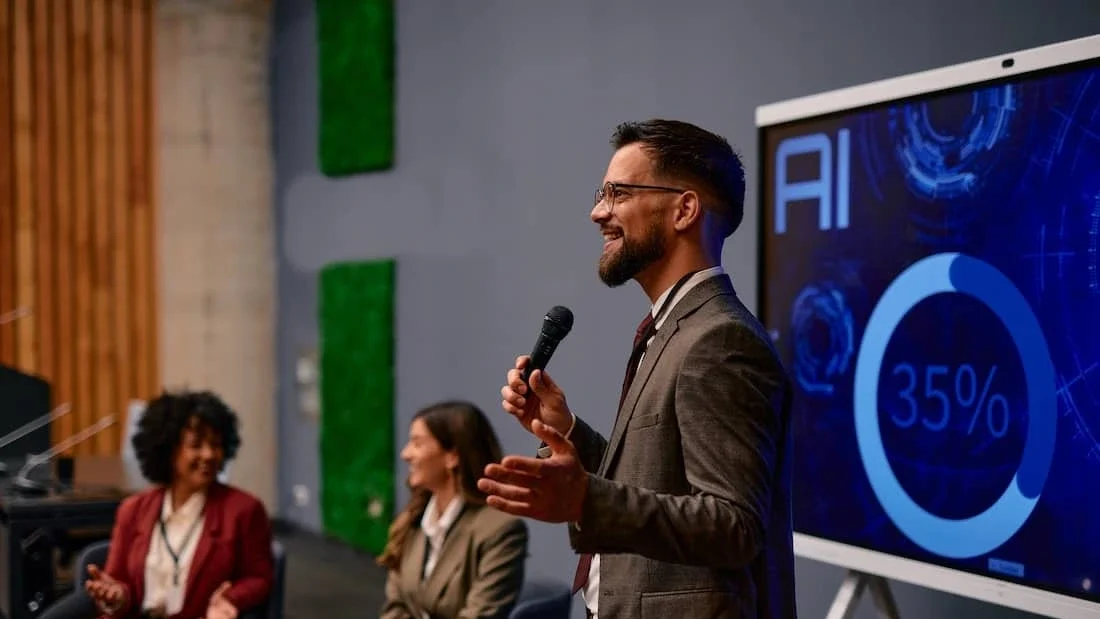
Career Spotlight: Business Transformation Lead
Artificial intelligence pioneer Fei-Fei Li, sometimes called the “godmother of AI,” has long emphasized that AI should augment, not replace, human intelligence. That perspective is reflected in the work of business transformation leaders, who help organizations use AI to improve processes, support decision-making, and enable people to work more effectively.
What Does a Business Transformation Lead Do?
If you’re considering a business-focused master’s in AI and see potential for the technology in business transformation, the role of business transformation lead shares skills in common with other change management professionals. Added to these human change management skills is proficiency in AI system design, deployment, monitoring, and governance. Business transformation leads are responsible for redesigning workflows in organizations, assisting humans in adopting new ways of working.
Leading Change Across Functions
AI business transformation leaders work with all departments of an organization rather than a single AI implementation team. They help:
- Align workflows across various teams
- Define roles in decision-making
- Direct how the AI implementation is structured
While an AI business transformation lead has plenty in common with other change leaders, like Agile or enterprise resource planning (ERP) implementation leaders, their role also evolves as their organizations change.
Translating Strategy Into Operational Change
“How can we do this better?” is an essential question for AI business transformation. Business transformation leads ask themselves this and more as they help design workflows and create AI adoption plans. This role directly contributes to how AI transforms business management and operations.
AI Is Changing Business Transformation Work
Some people have a simplistic and skeptical view regarding the purpose and end goals of AI in the workplace (e.g., eliminating jobs while improving the business’s bottom line). AI business transformation changes who makes decisions, when they are made, and how responsibility is shared across teams. As a fundamental technology, AI mandates a different approach to business transformation — one that does not just consider financial advantages but also benefits for everyone involved, from customers and vendors to executives and hourly employees.
AI Reshapes Workflows, Not Just Tasks
At first, it may be challenging to conceptualize the difference between task-based AI uses (which individuals undertake for their own purposes) and the numerous interconnected ways that AI transformation affects a business. Enterprise AI affects how work moves, how decisions are made, and how responsibilities shift across teams.
Transformation Now Requires AI Judgment
AI is rapidly moving beyond tool use to enterprise-wide implementations. Business leaders need to decide where artificial intelligence fits in their organization, what value it can bring beyond simply eliminating jobs or paperwork, and how it can strengthen overall value delivery and success. Good human judgment and sound AI judgment go hand in hand. The 2026 World Economic Forum report on AI implementation found that “AI transformation is failing far more often because of organizational design choices than because of technology limitations.”
Business Transformation Leads Help Organizations Move Beyond AI Pilots
Many organizations are finding that moving AI initiatives from pilot projects to enterprise-wide implementation is more challenging than building the technology itself. Common barriers include organizational readiness, employee adoption, governance, data quality, and integrating AI into existing business processes, not simply the capabilities of the AI models. Business transformation leaders help organizations address these challenges by aligning AI initiatives with business goals, supporting organizational change, coordinating stakeholders, and helping teams adopt new ways of working so AI projects can be implemented more effectively.
Many Organizations Struggle to Scale Change
AI pilot projects often do not move beyond beginning stages because of several interconnected problems. John Rossman, former Amazon executive and AI leadership expert, says that, “The pressure to appear innovative has overridden the discipline to be transformative.” From too many pilot projects and too few successes to unclear ownership and weak or poorly designed workflows and data pipelines, businesses face complex human challenges as they work to scale AI.
This Role Helps Make AI Real in Business Processes
Business transformation leads play an important role in moving AI initiatives beyond experimentation. They help organizations implement repeatable workflows, adapt operating models, and coordinate the people, processes, and technology involved in AI adoption.
Workflow Redesign Is a Core Part of the Role
Understanding how work gets done and why is a key skill in workflow design and redesign. In some ways, redesigning a workflow could be much more challenging than designing one from scratch. After all, it’s human nature to resist change, and we also become naturally (even if illogically) attached to the way things have always been done.
Transformation Leaders Rethink How Work Gets Done
Leaders in AI transformation begin by looking at current business processes. They pinpoint where change is needed and redesign/rebuild workflows so they run more smoothly and achieve optimal performance. This process relies on process mapping, analysis, and similar methods that help to locate bottlenecks and breakpoints.
AI Makes Workflow Design More Complex
Balancing the roles of an AI agent, human employee, supervisor, and business owner adds decision points to traditional workflows. Business transformation leaders in the AI era must incorporate new decision points, handoffs, and interactions between people and systems as they redesign workflows. Boston University’s (BU) Master’s in AI in Business curriculum covers the skills needed for mastering workflow redesign as well as understanding how and where AI changes decisions.
Adoption and Cross-Functional Coordination Matter as Much as the Technology
AI and business transformation rely on cross-functional coordination. A strong ability to analyze workflows and communicate with people matters just as much as underlying technology.
Change Only Works When People Use It
Comfort in the status quo, fear of the unknown, and a lack of clear understanding and communication all contribute to organizational and individual inertia. A business transformation leader needs a skill set that helps them drive adoption, align incentives, and support AI and business transformation across teams.
Cross-Functional Work Is Built Into the Role
Simply creating an AI tool or agent is only the start of creating any noteworthy organizational impact. To make change stick, a strong business transformation leader will be able to communicate with other leaders while working across operations as part of a functional team.
Business Transformation Leadership Also Requires Governance
One of the core questions in AI and business transformation is, “Who is responsible?” When AI systems are enabled to make decisions, an organized system of AI governance is necessary to support effective use and scaling.
Transformation Needs Clear Ownership
At BU, the online Master’s in AI in Business allows students to practice and gain clarity about who leads decisions and outcomes as well as provides oversight when AI is embedded into the workplace. Accountability for decision-making is a key focus of the program. The curriculum emphasizes how to clarify decision rights and identify ownership over AI initiatives.
Governance Helps Change Scale Responsibly
AI transformation leadership requires governance that keeps organizations and systems reliable, accountable, and aligned with established goals.
Improvement, Innovation, and Governance All Matter in This Role
AI-enabled transformation often falls under several connected categories, and effective leaders consider them all concurrently.
Some Transformation Work Focuses on Improvement
AI in business can help enhance efficiency and operational performance. It also may play a role in improving the quality of work within existing processes.
AI in business can support improvements in efficiency, quality, and operational performance. The curriculum emphasizes applying AI to improve existing business processes while exploring how humans and AI can work together through redesigned workflows, governance, and decision-making.
Some Transformation Work Focuses on Innovation
Transformation leaders can help businesses create new value, identify opportunities, and test fresh capabilities. For example, an AI-informed workflow in a service business might identify new customers through innovative marketing, then develop new services to meet their needs.
Governance Holds Both Together Over Time
Producing lasting results over time means embedding AI in business workflows along with stewardship and accountability. The Master’s in AI in Business is structured around the integrated challenges of continuous improvement, innovation, and governance in business AI.
What Skills Matter Most for a Business Transformation Lead?
Business AI transformation leaders rely on a blend of organizational, analytical, and people skills.
Workflow and Process Thinking
The ability to see and understand how work flows across systems and teams is crucial for a transformation lead. They must trace a process from start to finish while understanding how changes at any point will affect every other part of the workflow.
Organizational Judgment and Change Leadership
Business AI transformation leadership calls for strong judgment and the ability to balance performance goals, stakeholder needs, and long-term business sustainability. Professionals weigh competing priorities and make decisions that lead organizations and their people through the changes those decisions require.
Communication Across Business Contexts
Teamwork and translation are additional skills beneficial for transformation leaders for AI in business. They frequently work with different teams and translate complex change into practical action.
How BU’s Curriculum Connects to This Career Path
Boston University’s online MS in AI in Business coursework covers the challenges business transformation leaders face every day.
AI-Enabled Improvement
Module 2 provides practice in redesigning business processes and workflows by integrating AI into existing roles, routines, and decision systems. Students learn to apply AI in order to elevate efficiency and quality while addressing the trade-offs and risks that come with scaling.
AI-Enabled Innovation
The program’s Module 3 helps equip students to identify new opportunities and areas for innovation. It covers ways to design experiments under uncertainty, plus methods to lead the scaling of new AI-enabled capabilities within complex organizations.
Governance and Stewardship
AI governance is an emerging and developing field, and students discover how to design governance structures and clarify decision rights as they move through Module 4. This module emphasizes keeping intelligent systems reliable, accountable, and aligned with business values over time.
Why This Matters for Future Business Leaders
In general, AI projects tend to face problems when transitioning from pilot projects to production due to human challenges, not technological ones.
AI Transformation Needs More Than Technical Fluency
Beyond simply understanding AI tools, the business transformation leader of the future must know how to manage change across teams, workflows, and decision environments.
This Is the Kind of Role That Shapes How AI Actually Gets Used
At the end of the day, business transformation leads are the people who will help determine whether AI becomes a sustainable business change or remains a short-lived experiment.
Learn More About How BU Prepares Students to Lead AI in Business
Looking to lead AI-enabled change and make an impact? Explore Boston University’s online MS in AI in Business. This business and artificial intelligence program supports leadership in AI in the context of business transformation, workflow redesign, and long-term governance while underscoring skills necessary for success in the field.
Learn more about the program’s curriculum and admissions requirements, and request more information to see how it fits your goals and interests.