news
editor’s introduction
by Megan Horn
In order to view Hito Steyerl’s video installation Liquidity, Inc. (2014), viewers lounge on judo mats placed on a platform that resembles a cresting wave. However, the architectural elements surrounding the video are markedly placid in comparison to the film’s jarring montage of weather forecasts, mixed-martial arts fighting, and social media references, that float and dissolve before digitally animated water. Special effects also make the video itself appear as though it were rippling. Steyerl’s layering of pop cultural references against the water’s surface is more than an analogy comparing liquid currents to flows of information in the digital world. The satirical weather reports and footage of destructive hurricanes shown on television and phone screens with cluttered web browser windows and tumblr pins of spoofs on Hokusai’s Great Wave also make water a subject of the digital flows as much as it can be used metaphorically to describe the digital. By juxtaposing disparate pop cultural, economic, geopolitical, and meteorological terms, Steyerl's Liquidity, Inc. emphasizes interconnectedness of fluid systems driving weather patterns and the currents of geopolitical struggles and financial crises in globalized capitalist systems.
Hito Steyerl’s work emphasizes the shared root between the words currency and currents. However, as recent scholarship in the blue humanities would argue, this relation is more than a metaphor; the ocean and other watery systems are in fact entangled with human conflict, commerce, and culture.1 The blue humanities is an interdisciplinary approach to humanistic studies that considers not only the ways in which oceans impact both human creativity and imagination, but also the interactions between human and non-human entities and environmental concerns. For instance, Kimberley Peters and Philip Steinberg even use the concept of the ocean, and all that it intermingles with, as a “Hypersea” to describe how the ocean exceeds its liquid form, perpetual cycles, or a specific body of water by permeating and shaping physical matter, such as the atmosphere and our bodies, but especially our imaginations.2
Peters and Steinberg’s work provokes a reconsideration of the relationship between elements in Liquidity, Inc. as more than disparate units circulating in the digital world. In previous writing, Steyerl has described the “poor image,” or the low-resolution, reshared, and memed images and videos that circulate on the internet, as dematerialized but deeply connected to everyday reality because of their instantaneous and constant circulation.3 In this artwork, the liquidity of assets or navigating the changing economic, digital, and geopolitical terrains is far from immaterial. Although Steyerl approaches the aquatic as alienated and heavily mediated in Liquidity, Inc., another perspective on her work foregrounds the ways that the aquatic shapes our imagination of the digital world and provides a vocabulary for its streams of data, fluidity, and amorphousness. Concurrently, the capitalistic and industrial systems that Steyerl’s video references can be understood as having real, material impacts in their contribution to the acceleration of climate change.
In this vein, this issue of SEQUITUR presents scholarship that applies the interdisciplinary approaches of the blue humanities to works of art spanning the early modern era to the present. “Currents” here refers not only to the aquatic, but to the perpetual motion and circulation of non-human materials, ideas, and people. The authors in this issue frame the ocean in the work of artists, architects, and collectors as not merely a backdrop but also as a site of imperial conquest, extractivism, and profit; as a site of migration, speculative inquiry, and rife with potential resistance.
In this issue, Carolyn Hauk discusses the idea of submersion in Renee Royale’s photographic series Landscapes of Matter, in which the artist exposes the Polaroid prints to water collected from the Mississippi River. By submerging, and thereby subjecting, the Polaroid to the inorganic chemical detritus accumulated from petrol extraction and agricultural runoff in Louisiana’s wetlands, the altered photographs challenge conventional notions of the archive and the role of sight in the production of knowledge. Hauk’s essay underscores how Royale’s abstracted photographs destabilize the role of sight in the formation of knowledge as the images both archive ongoing ecological violence as well as subvert the use of photography in the documentation and speculation of land by white, settler-colonial economies.
Both man-made and natural forces also feature in Melody Hsu’s close analysis of the oyster-celadon bowl, once prized by the Qianlong Emperor (1735-1796), again unsettling an anthropocentric art history. This Ru ware bowl, fused by the ocean with a once-living oyster shell, embodies qualities of the marvelous appreciated within Chinese philosophical and aesthetic traditions and exemplifies how chance and oceanic forces shape this man-made object’s meaning. Here, the composite object exemplifies not only the aesthetic potential, but also the imaginative potential between tidal and cultural forces.
However, as Fatema Tasmia’s essay shows, beyond producing aesthetic and philosophical value, oceanic currents can be harnessed to capitalize on and commodify even the most transient states of water. Tasmia’s essay considers the architecture and material culture of the Indo-American ice trade and how the infrastructure and habits that centered on this fragile and melting luxury became both preservatives for cosmopolitan food and drink and the comfort of white bodies, as well as indicators of colonial modernity in India’s warm climate.
In the context of nineteenth-century America, Sybil F. Joslyn’s research spotlight proposes the concept of Salvage Culture, a framework concerned with material recovery, value, and reward, and how it might be applied beyond shipwrecks to the work of scrimshanders and the collecting of ship figureheads. In doing so, Joslyn proposes readings of scrimshaw not only in their context at sea, but as a means through which whaling crewmembers might have found creative value in the repurposing of whale byproducts. Similarly, the collecting of figureheads might be reevaluated aesthetically and culturally through this framework as sculptures evocative of an American golden age of commerce.
Nathaniel Craig reviews Stacy Alaimo’s recent The Abyss Stares Back: Encounters with Deep-Sea Life (2025) as a contribution to the blue humanities and with particular attention to Alaimo’s idea of “mediated intimacy.” Craig acknowledges that the affective potential of aesthetic experiences of the deep sea that Alaimo argues for may in fact increase ethical concerns for the life threatened by climate change and underwater drilling. At the same time, this review raises the issue that, while the aesthetic encounters might prompt imagination, speculation can also serve to imagine and transform material into profit. Craig’s review ponders how the visual might be leveraged in service of our oceanic world and what systems (neoliberal, colonial, etc.) need to be attended to in order to do so responsibly.
Considering curatorial practice, Jessica Braum reviews the exhibition Isamu Noguchi: Landscapes of Time (July 19-October 13, 2025) at the Clark Art Institute and its ambitious consideration of the sculptor’s engagement with time, cross-cultural experience, and material interdisciplinarity. Braum’s review points to the exhibition’s strengths in bringing together works by Noguchi which most clearly resist a linear sense of time yet also bring together the past, present, future in their geological and human-shaped materiality and their evocation of perpetual motion. This review also provides a critical lens into the ways in which adhering to a tight curatorial theme might constrain the possibilities of reading the works as unbounded temporally, materially, and culturally.
Together, these contributions offer a rich exploration of how artistic activity and material culture make visible, help detect, and even resist the invisible forces at work in our world.
____________________
Megan Horn is a third-year PhD student. She studies twentieth-century American photography and material culture. Her research focuses on the interrelationships between documentary photography and the negotiated conceptions of national identity. Megan has previously held positions at the Museum of Modern Art and the Newport Art Museum.
____________________
1. John R. Gillis, “The Blue Humanities,” Humanities 34, no. 3 (June 2013), https://www.neh.gov/humanities/2013/mayjune/feature/the-blue-humanities.
2. Kimberley Peters and Philip Steinberg, “The ocean in excess: Towards a more-than-wet ontology,” Dialogues in Human Geography, 9, no. 3 (2019): 293-307.
3. Hito Steyerl, “In Defense of the Poor Image,” e-flux journal 10 (November 2009): 9. http://worker01.e-flux.com/pdf/article_94.pdf.
Submerged Histories: Watery Archival Practice in Renee Royale’s Landscapes of Matter
by Carolyn Hauk
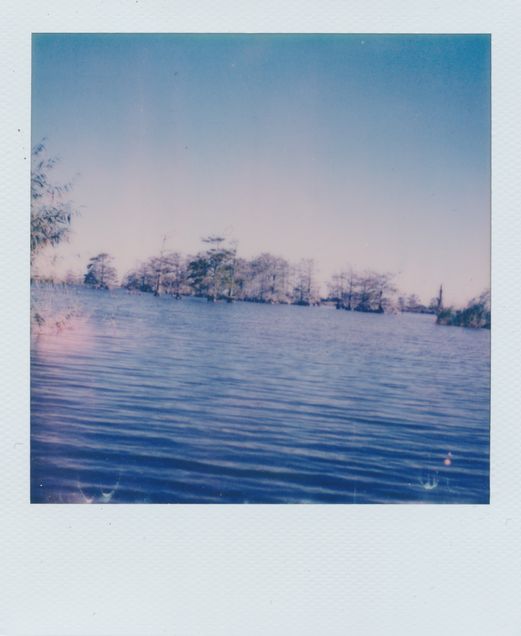
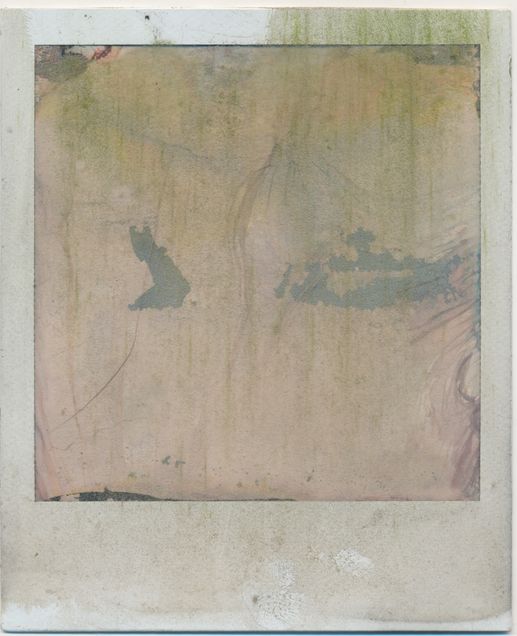
Submersion is at the center of Renee Royale’s photographic series Landscapes of Matter. In November 2021, Royale photographed landscapes and waterscapes with a Polaroid camera around Venice, Louisiana, the last stretch of walkable and drivable land before the Mississippi River plunges into the Gulf of Mexico. After each image developed, Royale submerged the prints in mason jars filled with water and soil she collected from the wetlands of Venice.1 Over twenty-eight days, the organic matter dislodged the emulsion layer from the frame and spread the dyes across the surface, creating an abstracted version of the pre-immersion photograph. Royale refers to this soaking process as a “second development” for these images.2 As an indexical practice, Landscapes of Matter documents the ecological changes to Louisiana’s coastal environment from the lasting effects of extractive plantation economies and racialized petro-capitalism.3 She writes that this series “exposes and archives the visual messages of ecological and racialized violence.”4 Through understanding Landscapes of Matter as an archive, we encounter submersion as a watery archival method and ethic that decenters Western, anthropocentric notions of what constitutes archivable records as well as epistemological practices that privilege sight as a form of knowledge-making.
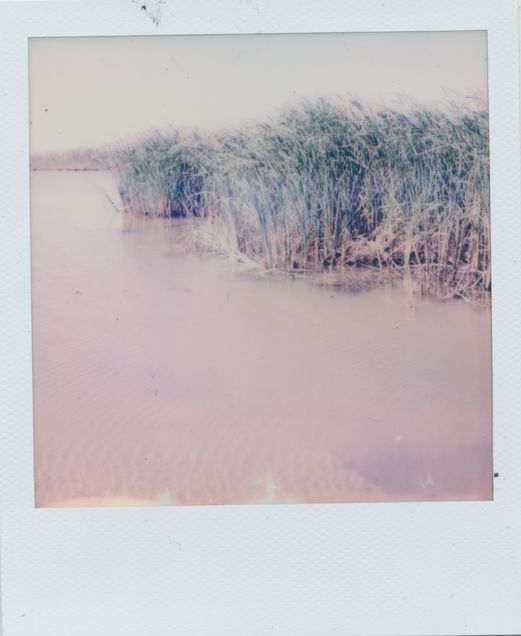
A few of Royale’s pre-immersion Polaroids appear as if taken from a watery vantage point, where marsh-millet and bald cypresses sprout from their subaquatic roots (figs. 1 and 2). Framed by the water, these particular images present a sense of unlandedness, a formal element whose valence is compounded when we consider the physical wateriness activated by their submersion in the jars. Scholars have offered submersion as a decolonial and recuperative method for surfacing social ecologies, knowledge systems, and practices that refute state power and extraction. Among them, Macarena Gómez-Barris frames “submerged perspectives” as a decolonial mode of seeing “below the surface of liquid, beyond normative modes of apprehending landscape, and toward a perception of the complexity within smaller scales of being and imagining.”5 Royale’s work considers the submerged perspectives that can surface in an archival sense through this epistemological practice.
As it is activated in Royale’s work, submersion recognizes the Mississippi River as a living entity and acknowledges its histories, including those that unfold independent of human activity. Between decades of accumulated detritus from white settler-colonial occupation of the river and high levels of agricultural runoff, PCBs, and plastic pollution, the Mississippi River contains inorganic elements that endanger the communities of humans and other-than-humans who depend on the river. These pollutants derive from the long arc of the plantation complex and its twentieth- and twenty-first century iterations: the extraction of oil and gas from Louisiana’s wetlands and coast, the continued displacement and violent dispossession of Black and Indigenous communities, and the environmental havoc levee-based water management systems continue to wreak.6 In steeping each Polaroid within the water of the Mississippi River, Royale exposes the formulation of the image to industrial pollutants—the storied matter of plantation extraction—and organic sediment and plant life, carried and redistributed by the river’s own time cycles.7
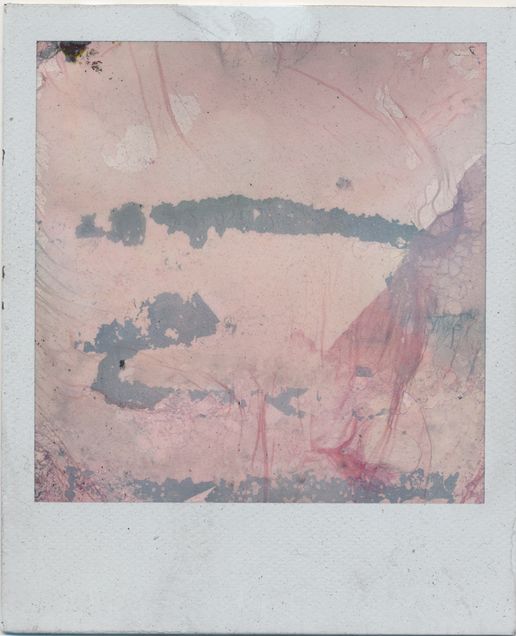
Upon their reemergence from the mason jar, the images of the cypresses and millet are no longer comprehensible: the emulsion layers have lifted and creased, the ink that once held the image has bloomed and migrated across the print, a faint pink hue remains in place of the blues and browns of the water, and an algal green stains the surface, perhaps the imprint of living organic matter in the water (figs. 3 and 4). A mode of looking principally shaped by submersion denies those modes proposed by the state and corporations, where environments and climates are measured, plotted, and appraised for capitalist extraction. For scholars such as Elizabeth DeLoughrey and Tatiana Flores, there are far too many ethical considerations at stake for “transparent approaches” to representation that do not “insist on an immersive participation-engagement.”8 Rather, the abstracted Polaroids front the limitations of human perception in detecting and tracking environmental degradation, as well as challenge the pre-eminence of evidencing these changes through clinical imagery.
This is not to disavow the importance of satellite imaging and maps that document environmental loss. Sobering surveys of the Gulf Coast chart the gradual erosion of Louisiana’s wetland environments and coast over a period of eighty years due to sea level rise, levees and dams, increased off-shore dredging from oil and gas companies, and higher-intensity hurricanes.9 Similarly, in Landscapes of Matter, the disappearance of the images of Plaquemines Parish’s marshes after their immersion provokes a meditation on their future disappearance. But unlike the satellite imaging, Royale keeps site-specificity in focus against the apathetic distance of “big-picture” cartography. She invites the watery environment into her representational practice, and, in so doing, creates an archive that simultaneously documents the past and present in anticipation of future land disappearance.
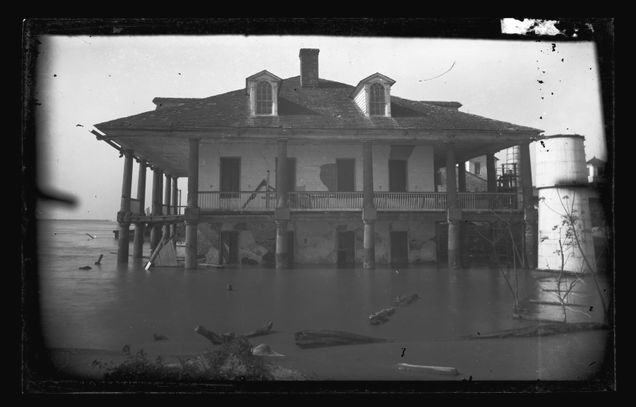
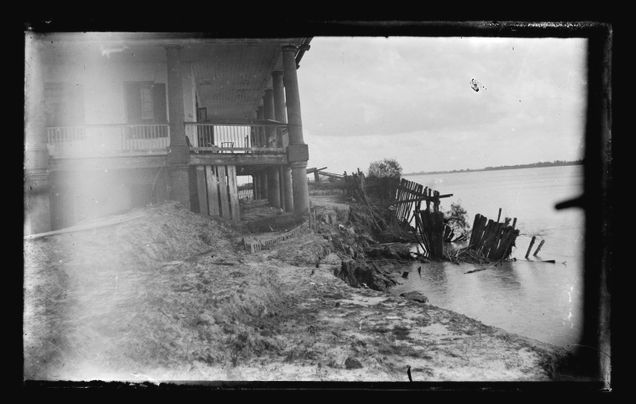
Landscapes of Matter is not the first instance where we find submersion amongst Louisiana’s wetlands and coasts in photographic archival practice. Dating approximately one hundred and thirty years prior to Renee Royale’s Polaroids from Venice, Louisiana, French photographer George François Mugnier documented an intense flood on the Belair Plantation in Plaquemines Parish, the same county where Royale produced her Polaroids. One of his gelatin silver prints shows floodwaters nearly reaching the second-story balcony of the estate (fig. 5). The plantation appears destroyed: a section of a fallen balustrade juts out from the water, chunks of plaster and shutters have been knocked off the exterior, and trees and other rubble float nearby. Another photograph depicts a collapsed riverbank following the flood (fig. 6). A new bank has accumulated from sediment and detritus deposited by the inundation, practically encasing the house within this new land formation. Once the floodwaters have subsided, what remains is a defunct, unprofitable ruin.
A photographer by profession, Mugnier documented the flood on Belair’s plantation as part of his broader entrepreneurial venture. His photographs fall alongside a history of disaster reportage through print culture, where natural catastrophes are captured, packaged, and disseminated for public audiences.10 Toward the end of the nineteenth century, images of natural disasters, including floods, increasingly prompted viewers to speculate on the reconstruction of buildings and infrastructures to ensure the continuity of capitalist extraction, growth, and profit.11 Mugnier’s photographs similarly document the devastation at Belair with clear and legible—albeit jarring—imagery of land loss for settler-colonial audiences to visually assess the damage and contemplate the project of reconstructing the plantation. Whereas Royale decenters vision as an epistemological and archival practice through rendering photographed landscapes indiscernible, Mugnier’s prints prompt a “speculative vision”—to borrow Anna Arabindan-Kesson’s term—in which land erosion is recorded and “ledgered” as a temporary setback in the course of colonial prospecting, extraction, and profit.12
Yet, amongst his many photographs of the Belair plantation’s flood, Mugnier annotated one in a photographic album: “The next new levee will be built behind this residence, and it will then be swept to the Gulf by the mighty Father of Waters.”13 There is a possible ambivalence here. On one hand, Mugnier conceptualized ongoing levee reconstructions to sustain further plantation production. Or, similar to Royale, Mugnier imagined a future in which the floods of the Mississippi River—heightened by the restrictive levee system—continue to inundate and destroy riverside settlements and cities. In so doing, he foretells the ruination of plantation monoculture and related infrastructures. While it is difficult to know the extent to which Mugnier aligned himself with the interests of the plantocracy in the Southern United States, white settler-colonists often deployed ruination ideology in the late nineteenth-century in service to capitalist extraction and the project of U.S. expansionism.14 Ruination is also invoked in Royale’s photography through the dissolvement of the image on the Polaroid, though it functions quite differently here. Allison K. Young, for example, has positioned Landscapes of Matter specifically as “de-creation through which the trauma of the plantation is negated, and an alternate future (one not defined by the slavery’s afterlife) becomes possible to imagine.”15 Submersion—even as a process of ruination—can still be productive and recuperative, as evidenced by Royale.
As she activates submersion in her work, Royale addresses the histories of environmental degradation and catastrophes that have disproportionately impacted communities of color. Submersion becomes a tool with which she opens archival practice to include other-than-human agents in documenting these histories in regions that are most vulnerable to extractive regimes. The result is, in her words, a photographic collection that is at once “micro-historical, genealogical, geological.”16 She records the inorganic matter of the Mississippi River that evidences multiple temporalities of ongoing ecological violence imperceptible to the human eye while acknowledging the subjectivity of the river and its ecologies. As Royale has demonstrated, submersion holds the possibility to destabilize sight as a privileged form of knowledge-making. It finds potential within ruination to challenge normative and oftentimes colonial forms of environmental representation in archives and scientific imagery. It articulates what the latter forms cannot: a history documented beyond the limitations of anthropocentric sensibilities.
____________________
Carolyn Hauk is a fourth-year PhD candidate in the Department of Art History at the University of Delaware. Her research explores the intersection between empire and environment in art and visual culture of North America from the 19th to early-20th centuries, with a particular geographic focus on the Southern United States.
____________________
1. Renee Royale, “Landscapes of Matter,” (artist website) https://www.reneeroyale.com/photography/landscapesofmatter, accessed September 26, 2025.
2. Renee Royale in discussion with the author, October, 20, 2025.
3. Allison K. Young, “Visuality and the Plantationocene: The Panoramas of Regina Agu,” Panorama: Journal of the Association of Historians of American Art 8, no. 1 (Spring 2022), https://doi.org/10.24926/24716839.12985; Siobhan Angus, “Chemical Necromancy: Plantations and Petrochemical Refining in Cancer Alley,” liquid blackness 8, no. 2 (2024): 16–33, https://doi.org/10.1215/26923874-11270445.
4. Royale, “Landscapes of Matter” (italics added).
5. Macarena Gómez-Barris, The Extractive Zone: Social Ecologies and Decolonial Perspectives (Duke University Press, 2017), xiii.
6. See for example: Wesley James, Chunrong Jia, and Satish Kedia, “Uneven Magnitude of Disparities in Cancer Risks from Air Toxics,” International Journal of Environmental Research and Public Health 9, no. 12 (2012): 4365–85, https://doi.org/10.3390/ijerph9124365; Craig E. Colten, "Environmental Management in Coastal Louisiana: A Historical Review," Journal of Coastal Research 33, no. 3 (May 2017): 699-711, https://doi.org/10.2112/JCOASTRES-D-16-00008.1 ; Christopher Morris, "Reckoning with ‘the Crookedest River in the World’: The Maps of Harold Norman Fisk," Southern Quarterly 52, no. 3 (Spring, 2015): 30-45,170, Pro-Quest.
7. Royale herself writes that nature works as a “co-creator” in Landscapes of Matter. This new materialist approach to photographic processes has been explored by Elizabeth Hutchinson in her research on nineteenth-century survey photography. See Elizabeth Hutchinson, “‘Photographic Weather’: A Posthumanist Approach to Western Survey Photography,” Panorama: Journal of the Association of Historians of American Art 6, no. 2 (Fall 2020), https://doi.org/10.24926/24716839.10862.
8. Elizabeth DeLoughrey and Tatiana Flores, “Submerged Bodies: The Tidalectics of Representability and the Sea in Caribbean Art,” in Liquid Ecologies in Latin American and Caribbean Art, eds. Lisa Blackmore and Liliana Gómez (Routledge, 2020), 166.
9. For example, see the diagrams in Caitlyn Kennedy, “Underwater: Land Loss in Coastal Louisiana since 1932,” Climate.gov, April 5, 2013, https://www.climate.gov/news-features/featured-images/underwater-land-loss-coastal-louisiana-1932 .
10. For example, see Genoa Shepley, “By Which Melancholy Occurrence: The Disaster Prints of Nathaniel Currier, 1835–1840,” Panorama: Journal of the Association of Historians of American Art 1, no. 2 (Fall 2015). https://doi.org/10.24926/24716839.1518.
11. Kevin Rozario, The Culture of Calamity: Disaster and the Making of Modern America (University of Chicago Press, 2007), 83.
12. Anna Arabindan-Kesson, Black Bodies, White Gold: Art, Cotton, and Commerce in the Atlantic World (Duke University Press, 2021).
13. George François Mugnier, annotation in his photograph album, 1884-1894. Historic New Orleans Collection. https://catalog.hnoc.org/web/arena/search#/entity/thnoc-archive/2016.0386.1.1/g.f.-mugnier-photograph-album.
14. See Maggie Cao, Painting U.S. Empire: Nineteenth-Century Art and Its Legacies (University of Chicago Press, 2025) and K. Stephen Prince, “The Burnt District: Making Sense of Ruins in the Postwar South,” in The World the Civil War Made, eds. Kate Masur and Gregory P. Downs (University of North Carolina Press, 2015).
15. Allison K. Young, “Renee Royale’s Landscapes of Matter: Photography at the End of the World,” liquid blackness 8, no. 2 (2024): 83. https://doi.org/10.1215/26923874-11270429.
16. Royale, “Landscapes of Matter.”
notes about contributors
Megan Horn is a third-year PhD student. She studies twentieth century American photography and material culture. Her research focuses on the interrelationships between documentary photography and the negotiated conceptions of national identity. Megan has previously held positions at the Museum of Modern Art and the Newport Art Museum.
Carolyn Hauk is a fourth-year PhD candidate in the Department of Art History at the University of Delaware. Her research explores the intersection between empire and environment in art and visual culture of North America from the 19th to early-20th centuries, with a particular geographic focus on the Southern United States.
Melody Hsu is a PhD student in Art History at McGill University, supervised by Prof. Angela Vanhaelen and a recipient of SSHRC doctoral funding. Her research explores the (re)making and exchange of visual and material culture between the Low Countries and East Asia, and early modern prints’ transregional, transcultural, and transmedial trajectories.
Fatema Tasmia is a PhD candidate in the History of Art & Architecture at Boston University. Her research focuses on Tropical Modernism, materiality, and labor in postcolonial South Asia. She has recently presented at SAH 2025 and the Docomomo International Conference 2024. She enjoys traveling, photography and visual narrative storytelling.
Sybil F. Joslyn is a PhD candidate in the History of Art & Architecture at Boston University. She specializes in visual and material culture in America’s long nineteenth century, with her dissertation exploring the role of maritime salvage as process and material in art production and the history of collecting.
Nathaniel Craig received his bachelors from Binghamton University in mathematical sciences and art history before returning as a graduate student in the art history program. His current research focuses on the architecture of home economics.
Jessica Braum (she/her) is a doctoral candidate in Art History at Temple University. Her dissertation examines Kim Lim’s print and sculptural practice through transnational feminist frameworks, reassessing postwar British and Southeast Asian art histories. Engaging feminist theories and multidisciplinary methods, she studies artists working across geographic and cultural contexts. Her writing has appeared in Asian Diasporic Visual Cultures and the Americas, ASAP/Journal, and Passage.
Isamu Noguchi: Landscapes of Time
Clark Art Institute, Williamstown, MA
July 19, 2025–October 13, 2025
by Jessica Braum
A quiet constellation titled Akari Light Sculptures (c. 1951–76), poetically luminous and palpably weightless, floats at the center of Isamu Noguchi: Landscapes of Time (July 19, 2025–October 13, 2025), immediately capturing the viewer’s gaze and establishing a sense of ephemerality that attunes visitors to Noguchi’s enduring engagement with the concept of time (fig. 1). Located in the Michael Conforti Pavilion of the Clark Art Institute, a rectangular gallery space bounded by glass on three sides, the exhibition presents a non-chronological selection of the artist’s works framed by Noguchi’s “fascination with time [and]...his broader search for belonging.”1 By tracing flows of influence, material processes, and cultural intersections, the exhibition showcases Noguchi’s formal innovation and emphasizes the ethical and imaginative possibilities of engaging with time and transnational cultural currents as forces that shape human experience and artistic expression. Addressing these themes together is an ambitious undertaking, one that exposes a tension between the exhibition’s conceptual scope and its cohesive execution.
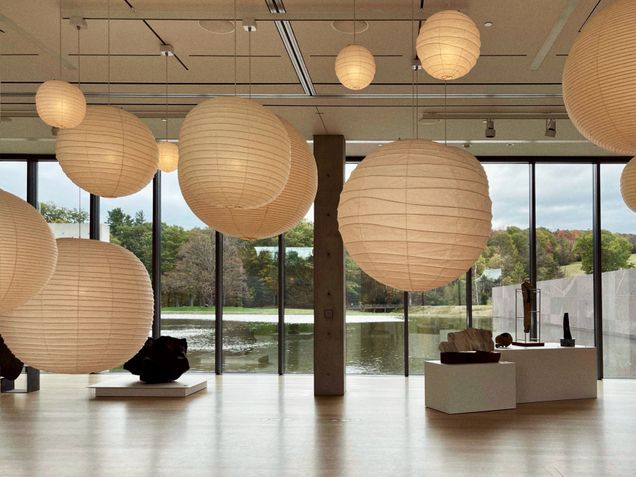
Yet the dominant sensory appeal of the Akari risks flattening the curatorial narrative, reducing Noguchi to a poetic modernist rather than an artist deeply engaged with questions of material, space, and time. Noguchi himself conceived of the Akari not merely as decorative objects, but as extensions of his early experiments with self-illuminating sculpture—a series of works linked by their internal light and by titles invoking the lunar.2 This titular reference to the moon is instructive; Noguchi likened his memory of confinement in Poston, an internment camp in Arizona, where Japanese Americans were forcibly relocated during World War II, to “that of the moon, a moonscape of the mind… an illusion within the confines of a room or a box, where the imagination may roam to the further limits of possibilities, to the moon and beyond.”3 The Akari thus echo this interior landscape of imagined expansiveness. However, the curators’ decision to foreground washi paper lanterns, objects traditionally associated with Japan, offers an entry point while also reinforcing a simplified narrative of cultural symbolism—an emphasis that gestures toward the exhibition’s investment in curatorial cohesion.
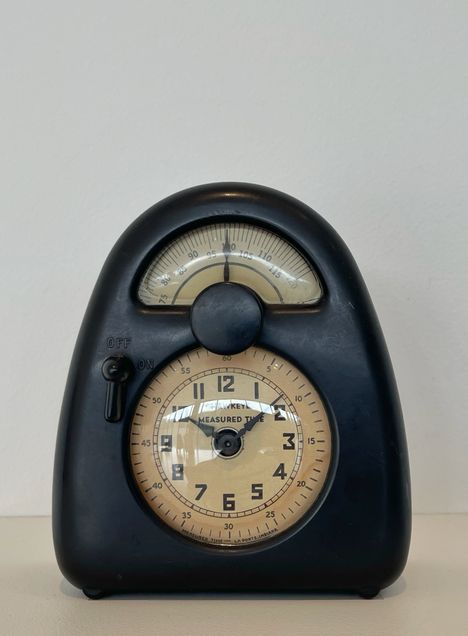
Moving outward from the Akari at the center, the gallery’s perimeter offers a more expansive view of Noguchi’s engagement with time across media, scale, and collaborative practice. The selection of artworks reflects six decades of Noguchi’s practice and situates him within the broader discourse of global modernism. The earliest work on view, Measured Time (1932), a design for a commercial kitchen timer, is tightly framed within the exhibition’s thematic parameters, leaving less room for a more nuanced understanding of the artist (fig. 2). The object offers a literal expression of the curatorial premise, standing in stark contrast to the surrounding sculptures, whose engagement with time is more abstract and complex. The didactic text’s reference to Noguchi’s “lifelong preoccupation with time” sits uneasily with the object, underscoring the exhibition’s occasional overreliance on thematic coherence.
Nevertheless, subsequent works introduce a more layered account of Noguchi’s engagement with time and his disregard for hierarchies between disciplines, as well as his dialogues with other interlocutors. For example, Spider Dress and Serpent for Martha Graham’s Cave of the Heart (1946) link Noguchi not only with Graham, one of his most important collaborators, but also with theater through his work on set and costume design. This multidisciplinary engagement was formative, offering him a conception of space as “an open volume within which the illusion of infinite space may be created.”4 The work The Seed (1946; fabricated c. 1979), a tripartite abstraction with a polished metallic finish, recalls the sculptural syntax of Constantin Brâncuși, with whom Noguchi apprenticed as a stonecutter in Paris.
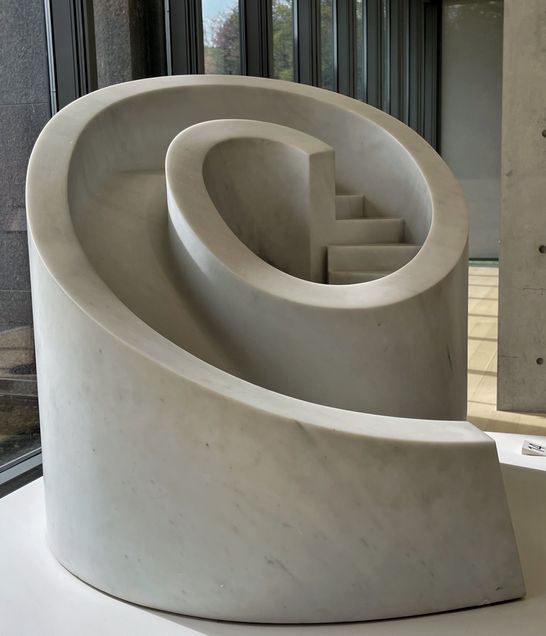
A large-scale photograph of Sculpture to Be Seen from Mars (1947) spans the gallery’s innermost wall, depicting a sand model for an unrealized monumental sculpture composed of colossal earth mounds that together suggest the shape of a human face. Flanking this image in a striking reversal of scale, a selection of maquettes and plaster models invites viewers to imagine the ambition of Noguchi’s public works and play equipment. Slide Mantra Maquette (1985), a scale model for a ten-foot marble slide constructed for the 1986 Venice Biennale, exemplifies Noguchi’s philosophy of “humanizing space” (fig. 3).5 Its spiral form unites ascent and descent—progress and return—embodying Noguchi’s belief that the past is not simply gone but remains embedded within the motion of life and art.
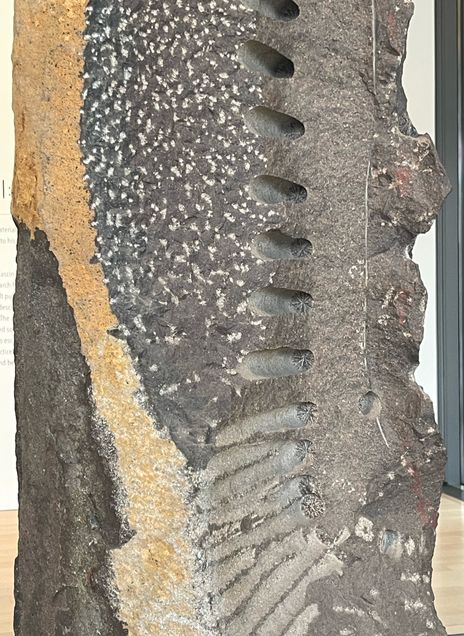
Noguchi’s broader practice resists linearity and embraces what he called a “radiant” sense of time, extending in all directions—past, present, and future alike.6 His reflections on “the quality of enduring” and the necessity of imperfection point to an understanding of sculpture as a living process, inseparable from nature, memory, and human experience.7 Two of the most evocative pieces in the exhibition, This Earth, This Passage (1962; cast 1963) and Age (1981), may be read as unfolding meditations on duration, recurrence, and geological time. This Earth, This Passage, displayed directly on the floor, materializes Noguchi’s exploration of time by recording his circular steps in wet clay, later cast in bronze (fig. 4). The resulting form captures cyclical motion, the imprint of walking as both process and residue, suggesting the overlap of past and present, history and imagined futures. Age, a basalt sculpture, stands close to the gallery’s entrance, its surface bearing an expansive language of carved marks intertwined with traces of natural processes (fig. 5). Noguchi deliberately left portions of the stone’s ochre surface untouched, preserving the natural crust formed by slow oxidation, a record of the material’s own transformation. The variety and rhythm of carved marks are, at times, painterly: some recall drops of ink dispersing in swirls and loops of water, while others reveal the stone’s resistance to Noguchi’s tools, recalling a lesson he learned as Brâncuși’s stonecutter, that “the large saws…must not be forced but gently cut of their own weight. The wide blade of the axe leaves its mark, and that is how it should be left—the direct contact of man and matter.”8 Together, these works visualize sculpture as an interaction between artist and matter, positioning time and change as both human-directed processes and geological forces.

The exhibition’s ambition to address time, belonging, interdisciplinarity, and cross-cultural experience reveals a productive yet unresolved tension between conceptual breadth and spatial limitation. Some of the larger works, including Time Thinking and Spin-off #2 from Sunken Garden, Chase Manhattan Bank Plaza, are positioned in a tight linear sequence along the gallery’s windowed left wall, where the narrow proportions of the space dampen their spatial vitality.
Curated by Matthew Kirsch and Kate Wiener, Landscapes of Time succeeds in conveying Noguchi’s sensitivity to material and his commitment to working across disciplines, yet his more speculative and cross-cultural investigations remain only partially realized. Noguchi’s own reflections on belonging—rooted in a bicultural life between Japan and the United States, as well as in a peripatetic, world-spanning practice—underscore the multiplicities that shape his practice. His sculptures inhabit the interstice between permanence and transience, matter and imagination, suggesting that belonging itself may reside within this movement, a continual becoming that, like his imagined moonscape, transforms constraint into boundless possibility.
A final, unexpected impression arises from the viewer’s engagement with the gallery’s atmosphere. Because the exhibition text was distributed as a pamphlet rather than mounted on the walls, visitors frequently read aloud to one another, generating a low hum of voices throughout the space. Fragments of biography and interpretation, floating alongside the works, lent an auditory dimension to Noguchi’s search for meaning across time, place, and material, quietly echoing the luminous Akari at the exhibition’s center.
____________________
The artworks and reproductions thereof are expressly excluded from any open-access or open license grant of rights. All rights are expressly reserved by ARS on behalf of the Artist, Estate or Foundation.
____________________
Jessica Braum (she/her) is a doctoral candidate in Art History at Temple University. Her dissertation examines Kim Lim’s print and sculptural practice through transnational feminist frameworks, reassessing postwar British and Southeast Asian art histories. Engaging feminist theories and multidisciplinary methods, she studies artists working across geographic and cultural contexts. Her writing has appeared in Asian Diasporic Visual Cultures and the Americas, ASAP/Journal, and Passage.
____________________
1. Clark Art Institute and The Isamu Noguchi Foundation and Garden Museum, Isamu Noguchi: Landscapes of Time (Clark Art Institute, 2025), 1.
2. Naguchi’s self-illuminating sculptures include Lunar Infant (1944), Lunar Landscape, and Red Lunar Fist (1944).
3. Isamu Noguchi, A Sculptor’s World (Thames & Hudson, 1968), 45.
4. Clark Art Institute and The Isamu Noguchi Foundation and Garden Museum, Isamu Noguchi: Landscapes of Time, 3-4.
5. “Isamu Noguchi: The Sculpture of Spaces.” 1995. Films On Demand. Films Media Group. Accessed October 22, 2025, https://fod.infobase.com/PortalPlaylists.aspx?wID=103640&xtid=32843.
6. Isamu Noguchi, “The Road I Have Walked,” in The Inamori Foundation: Kyoto Prizes & Inamori Grants, (Inamori Foundation, 1990), 125.
7. Noguchi, “The Road I have Walked,” 123.
8. Benjamin Forgey, "Isamu Noguchi's Elegant World of Space and Function," Smithsonian 9 (April 1978): 49, https://archive.noguchi.org/Detail/bibliography/1592.
An Oceanic and Imperial Treasure: The Southern Song Oyster-Mountain Celadon Bowl
by Melody Hsu

What if the sea is a genius artist? The Taipei National Palace Museum houses an enigmatic object of display: a Southern Song dynasty (1127–1278) celadon bowl fused within an oyster shell (fig. 1). The porcelain, with its flared rim and bluish-green glaze, sits perfectly within the oyster’s opening, framed rather than concealed. This uncanny harmony may suggest deliberate craftsmanship. However, this oyster-celadon bowl is the product of chance, natural forces, and perhaps a catastrophic accident. It belongs to the imperial collection of the Qianlong Emperor (乾隆帝, 1735–1796), where it was displayed in the Palace of Heavenly Purity (乾清宫).1 Likely recovered from the sea—possibly the result of a shipwreck—it embodies both human artistry and oceanic intervention: a collaboration between kiln and tide. The ocean thus becomes not merely a backdrop to history but an active maker of objects. It materializes what Steve Mentz describes as the sea’s role as “the most powerful nonhuman actor in world history.”2 By situating the oyster-celadon bowl within both the Qianlong imperial collection and blue humanities methodologies, this article explores how oceanic processes and Chinese aesthetic traditions together shape its status as a singular work of art. The bowl’s sea-forged materiality and its resonance with Tang-Song sensibilities for the strange and marvelous reveal a model of art-making in which otherworldly and natural forces play a constitutive role.
Recent scholarship in shipwreck art history and the blue humanities emphasizes moments when the sea intervenes as an agent of material production, breaking the boundaries of art-making traditionally attributed to human agencies. Taking Sara Rich’s concept of shipwreck hauntography, for instance, watery wreckage dismantles the boundaries between “past and present, sacred and secular, nature and culture, and particularly life and death”; a close encounter with shipwrecks in their underwater realm is a brush with “the eerie, horrific, and uncanny—but also the wondrous, ecstatic, and sublime.”3 The oyster-celadon bowl exemplifies this collapse: a mundane ceramic, through violent submersion and chance preservation, became an “extraordinary” work of art. Most shipwrecks yield fractured debris or fused detritus, yet occasionally, “shipwrecks can turn mere mass-produced objects into treasured sculptures of the sea.”4 The oyster-celadon bowl stands as precisely such an exception. Through its submersion and fusion with an (once-animated) oyster shell, a relatively ordinary celadon bowl was transformed into a treasured object. Its mysterious survival, fortuitous rarity, and above all, its material fusion of porcelain and shell, rendered it a one-of-a-kind treasure, once cherished by the Qianlong Emperor and today regarded as one of Taiwan’s most important antiquities (重要古物).
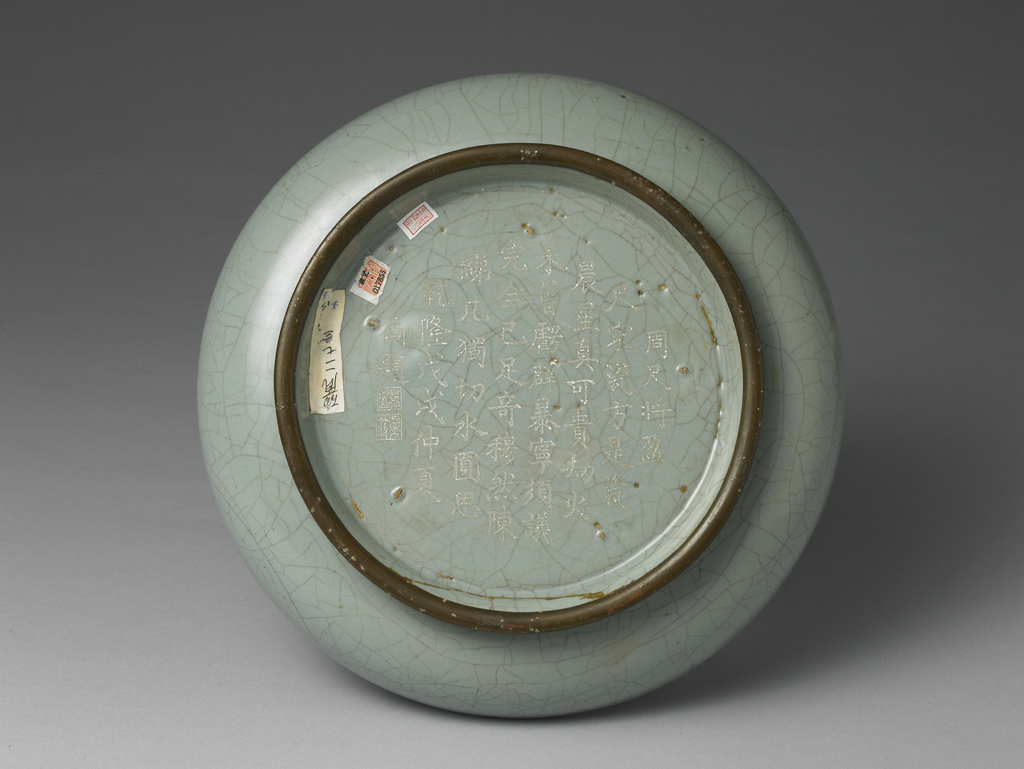
The Qianlong Emperor, known as the eighteenth-century Chinese imperial “chief curator,” devoted immense resources to expanding the imperial collections, and he personally appraised antiquities.5 Ceramics were among the emperor’s greatest passions; he composed nearly two hundred poems on the subject, often carving them directly onto his “curated” ceramics, thereby turning the objects themselves into markers of imperial connoisseurship. Qianlong once observed: “Buried in the earth and unearthed after thousands of springs, its mottled green hues spread with cracks across the body.”6 His writings reveal a keen sensitivity to the surface qualities of excavated ceramics created by their nonhuman actors. Most of all, he valued their “wholeness.” On a Northern Song Ru ware dish, he carved, “Even flaws need no debate, wholeness itself is rare indeed" (fig. 2).7 In his annotation, he further clarified: “Though an old ceramic may show slight flaws in glaze, it still counts as a treasured piece. But if it is newly made, such flaws relegate it to a lower grade.”8 These writings suggest that Qianlong valued traces of age and transformation, qualities reflected in the oyster–celadon bowl despite the absence of an inscription. Its materiality, shaped by both kiln and sea, would have resonated with his appreciation for rarity, antiquities, and the work of nonhuman forces.
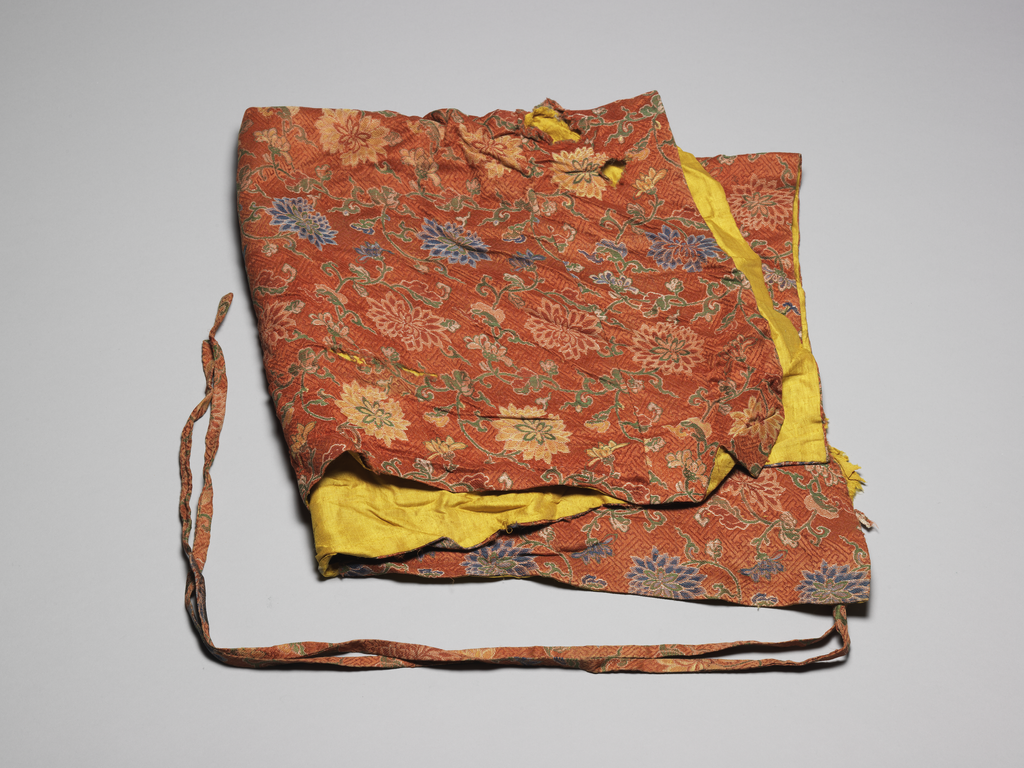
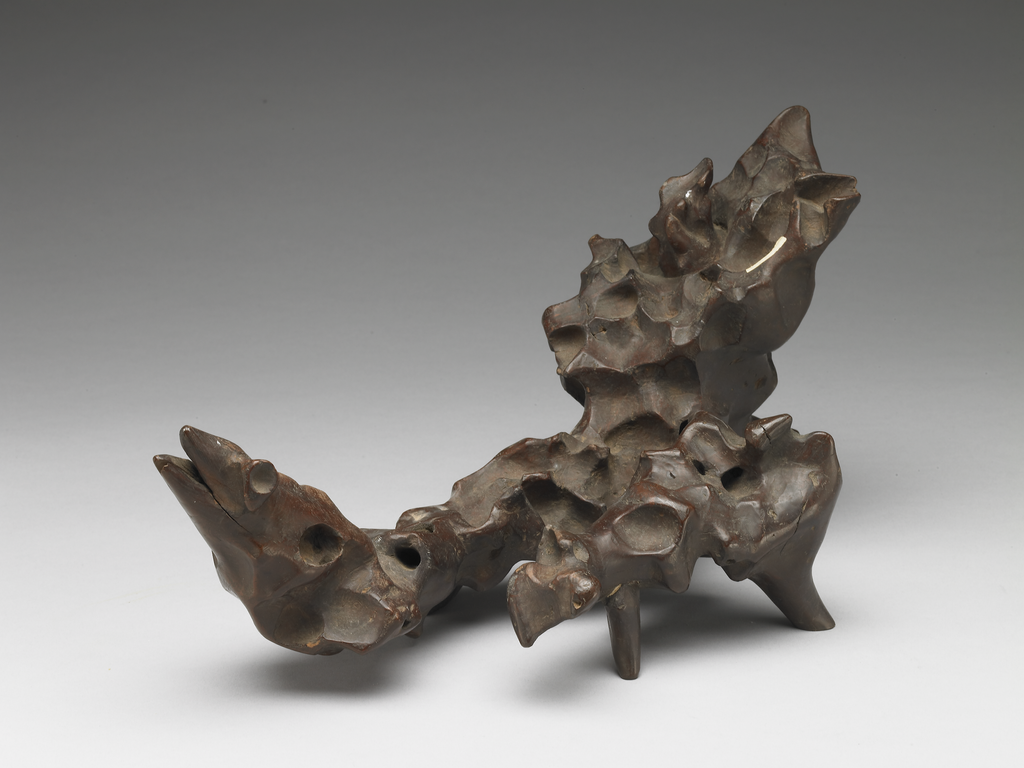
The care with which the bowl was collected further attests to its significance. A Qianlong-period brocade wrapper, patterned with red, yellow, green, and blue florals on a crimson ground, accompanied the piece, indicating it was carefully treasured within the imperial collection (fig. 3). Its name in Mandarin, Nan Song haoshan ciwan 南宋蠔山瓷碗 (which literally translates to “Southern Song oyster-mountain porcelain bowl”), also highlights its unique status (fig. 4).9 The term “mountain” here may refer to the rocky shape of the oyster shell itself, but it could also refer to the specially designed wooden stand, which was likely commissioned during the Qianlong reign (fig. 5). Carved from a single tree root, the stand preserves the root’s natural irregularities—its porous holes and angular protrusions—while only the feet show signs of deliberate man-made shaping. The oyster shell rests in a perfect angle on this wooden stand. This set of oyster, ceramic, and wood complements each other: human-made, oceanic, and terrestrial materials brought into harmonious balance.

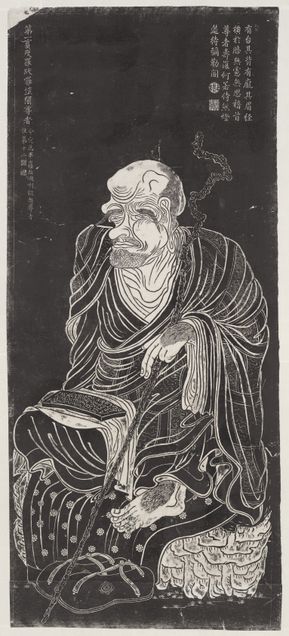
This aesthetic design resonates with sensibilities cultivated in the Tang-Song periods–eras of cultural, literary, and artistic flourishing that deeply inspired the Qianlong Emperor, who was also a devoted Buddhist. The irregular curvature and porous rock-like texture of the oyster–celadon bowl and its wooden stand evoke the categories of yi 異 (odd), qi 奇 (singular), and guai 怪 (fantastic), visual qualities that were prized in both literati and Buddhist aesthetics.10 This appraisal is exemplified in the Song dynasty’s literati appreciation and collecting practices surrounding “strange-looking” scholars’ rocks, whose twisted forms and perforated surfaces embodied the extraordinary and the otherworldly (fig. 6). This also resonates with the celebrated artwork Sixteen Arhats by the late Tang Chan master Kuan-hsiu 貫休 (832–912), whose grotesque and contorted portrayals of Buddhist monks similarly reflect a shared visual language of eccentricity and irregularity (fig. 7).11 Kuan-hsiu’s arhat bodies twist and contort in unusual ways, sometimes coagulating with the jagged rock formations that they sit against, blurring the boundary between organic and inorganic, animate and inanimate.12 These forms, rather than signaling degeneration or monstrosity, become pictorial forms for expressing spiritual “true forms” and visionary insight.
This visual and aesthetic resonance reflects a broader cultural context of the Tang–Song dynasties, when “strange-looking,” “grotesque,” “odd,” or even “ugly” shapes and objects were not merely admired for their unusual forms. They were more than curiosities: such objects were also imbued with philosophical and spiritual significance.13 The Tang period in particular also saw a flourishing of poetic reflections on gardens and individual rocks, which, much like landscape paintings, were treated as microcosms of the universe, offering scholars a medium for contemplation within the confines of a garden or studio.14 As Edward Schafer observes, Tang elites were especially drawn to “pseudonatural” rocks, those whose silhouettes evoked alien beings or fantastical creatures, whether naturally formed or deliberately carved.15 In the poem A Pair of Rocks, the Tang poet and statesman Bai Juyi (白居易772–846) describes rocks as “grotesque” and “ugly”—terms meant not to dismiss them, but to emphasize their unsettling otherworldly qualities. He likens them to sharp weapons and mythical creatures, such as dragons and tigers, thereby collapsing distinctions between the natural and the artificial, the animate and the inanimate.16 This blurring of boundaries finds a visual and metaphorical counterpart in the oyster-celadon bowl and its wooden stand—an object in which the sea acted as an active agent in the production, transformation, and aestheticization of its materiality. The fusion of man-made ceramic, natural materials, and natural forces underscores unpredictability, temporality, and nonhuman agency, revealing the dynamic interplay between human and nonhuman actors across time and space.

The Tang-Song fascination with strangeness and the marvelous thus provides a cultural lens through which to view the Qianlong Emperor’s appreciation of the oyster-celadon bowl. As Xiaoshan Yang notes, Tang and Song poetry often reveals a fetishistic attachment to rocks, a conviction that irregular, spiritually potent forms could elicit aesthetic and even moral reflection.17 This sensibility developed alongside broader Tang-Song societal transformations, including the expansion of the imperial examination system, which created new classes of scholar-officials and brought questions of identity and selfhood to the forefront of cultural expression. The Qianlong Emperor later built upon and further expanded this system. Irregular shapes hence came to symbolize individuality, spontaneity, and resistance to rigid social norms. Literati collectors increasingly prized grotesque rocks as emblems of personal expression, projecting their thoughts and emotions onto the surfaces of these unruly forms. Viewed in this light, Qianlong’s oyster-celadon bowl, resting in its oyster shell upon a root-carved stand, can be understood as an object that embodies eccentricity, singularity, and the marvelous—values long celebrated in Chinese philosophical and aesthetic traditions. The bowl thus reminds us that art need not be solely the product of human hands: the sea, as much as the kiln, shaped this oceanic and imperial object.
The lens of blue methodologies invites us to rethink the boundaries of art by showing that the pleasures afforded by and meanings that arise from the shifting interplay of matter, chance, and natural systems—currents moving across oceanic, temporal, and cultural scales. The oyster-celadon bowl exemplifies the generative potential of the nonhuman world, revealing how water, tides, and environmental forces shape not only material forms but also artistic imagination. It enacts a poetics of planetary water in which contingency, flow, and environmental agency displace human intention, producing a material encounter that can never be replicated in the exact same way. Such negotiations unsettle conventional narratives of anthropocentric art-making and relocate aesthetic production within a wider mesh of planetary processes. In this light, the manufactured celadon bowl becomes rearticulated through oceanic force into an otherworldly composite object. The smoothness of the ceramic glaze, the fine network of crackle lines, the jagged mineral surfaces of the oyster shell, and the sinuous contours of the wooden stand stage a multisensory performance, materializing both human and natural participation in its artistic production.
____________________
Melody Hsu is a PhD student in Art History at McGill University, supervised by Prof. Angela Vanhaelen and a recipient of SSHRC doctoral funding. Her research explores the (re)making and exchange of visual and material culture between the Low Countries and East Asia, and early modern prints’ transregional, transcultural, and transmedial trajectories.
____________________
1. Pei-Chin Yu, Magic of Kneaded Clay: Ceramic Collection of the National Palace Museum (National Palace Museum, 2018), 19.
2. Steve Mentz, “The Wet and the Dry: Shipwreck Hermeneutics,” in Shipwreck Modernity: Ecologies of Globalization, 1550/1719 (University of Minnesota Press, 2015), 2.
3. Sara Rich, “Preface: Hauntographies of Ordinary Shipwrecks,” in Shipwreck Hauntography: Underwater Ruins and the Uncanny (Amsterdam University Press, 2021), 13.
4. Aaron M. Hyman and Dana Liebsohn, “Lost and Found at Sea, or a Shipwreck’s Art History,” West 86th: A Journal of Decorative Arts, Design History, and Material Culture 28, no. 1 (2021): 54.
5. Yu Pei-Chin 余佩瑾, “Qianlong Emperor’s Taste of Ancient Porcelain 乾隆皇帝的古陶瓷品味,” The National Palace Museum Monthly Journal of Chinese Art 故宮文物月刊 345 (2011): 5-17.
6. The present author’s own English translation. Quote retrieved from: Yu Pei-Chin, “Qianlong Emperor’s Taste of Ancient Ceramics,” 6.
7. Yu, “Qianlong Emperor’s Taste of Ancient Ceramics,” 6.
8. Yu, “Qianlong Emperor’s Taste of Ancient Ceramics,” 6.
9. The present author’s own English translation.
10. Xiaoshan Yang, “Fetishism and its Anxiety,” in Metamorphosis of the Private Sphere: Gardens and Objects in Tang-Song Poetry (Harvard Asia Center, 2003), 103.
11. These portraits of enlightened monks are rendered in what Richard Kent describes as a “weirdly foreign style,” deliberately diverging from the more naturalistic and sinicized aesthetics of court portraiture. Sinicization, in this context, refers to the process by which foreign religious figures, the “original” Indian Buddhist icons, were gradually adapted into a Chinese visual idiom. One of the earliest known sinicized portraits of a luohan is the Arhat Kalika from Dunhuang. These sinicized depictions align with the naturalistic portraiture used for high-ranking clerics — historical patriarchs of Chinese Buddhist lineages – such as Li Chen’s Portrait of Amoghavajra (800). Kuan-hsiu, however, broke with these Chinese classical conventions. Instead, they are marked by staggering foreign features: bushy eyebrows, bulging eyes, pendulous jaws, and prominent noses. As a priest of the Ming period, Tzu-po Ta-shih, observed one such image: “The skull is extraordinary – hillocks alternating with hollows. The eyes lie deep under cliffs. Where they flash, nothing remains hidden” (Richard Kent, “Depicting of the Guardians of the Law: Lohan Painting in China,” in Latter Days of the Law: Images of Chinese Buddhism, 850-1850, ed. by Marsha Weidner (Spencer Museum of Art, 1994), 183-213).
12. “The pattern of folds continues… over the chest and neck and face, always in bundles of similar curves of a slightly geometric quality. This inorganic character of the lines, which are shaded in a peculiar, dry technique through modeling effect, is strongly visible… in the left foot, which almost looks skinned. On this worn-out body sits a grotesquely shaped head with features that speak of self-torture and desperate searching rather than victory or ultimate liberation” (Max Loehr, “Guan Xiu,” in The Great Painters of China [Harper and Row, 1980], 58).
13. “Grotesque” or “Ugliness” functions as an aesthetic category in opposition to idealized beauty—a beauty aligned with the dominant order, such as classical Chinese courtly art (e.g. on Chinese paintings for the “scholars” and the “gentlemen” see: Craig Clunas, Chinese Painting and Its Audiences [Princeton University Press, 2017]). Beauty, much like the imperial Chinese court itself, occupies the symbolic center: it is associated with ideals of “reason, truth, goodness, harmony, civilization,” and the rightful rule of the Emperor as the axis of the world. In contrast, the grotesque and the ugly are defined by their deviation from this normative ideal: they evoke “irrationality, excess, disorder, moral ambiguity, deformity, and marginality.” See Robert S. Nelson and Richard Shiff, Critical Terms for Art History (University of Chicago Press, 2003).
14. Robert D. Mowry, “Chinese Scholars’ Rocks: An Overview,” in Worlds Within Worlds: The Richard Rosenblum Collection of Chinese Scholars’ Rocks (Harvard University Art Museum, 1997), 19-23.
15. Yang, “Fetishism and its Anxiety,” 103.
16. Yang, “Fetishism and its Anxiety,” 100-102.
17. Yang, “Fetishism and its Anxiety,” 91-148.
The Abyss Stares Back: Encounters with Deep-Sea Life
by Nathaniel Craig
STACY ALAIMO
The Abyss Stares Back: Encounters with Deep-Sea Life
Minnesota: Minnesota University Press, 2025. 256 pp.; 9 color ills.; 12 b/w.
$27.95
9781517918736

Stacy Alaimo’s latest book, The Abyss Stares Back: Encounters with Deep-Sea Life (2025), examines ways to frame the deep-sea as an environmental concern in the popular imaginary. At stake is the fact that species are vanishing before we even know they exist, from climate change to deep-sea mining, their extinction occurring in darkness both literal and epistemological. To broach this problem, Alaimo utilizes an interdisciplinary approach, incorporating media studies to problematize the notion of objectivity, anthropology to emphasize our relationality with other creatures, and posthumanist thought to reevaluate which disciplines are privileged in knowledge production about the environmental as opposed to the cultural. The book proceeds by analyzing visual accounts of the abyss following two lines of inquiry: one historical, the other concerned with epistemology. In the former, Alaimo traces what she calls the “abyssal aesthetic,” one that prompts speculation, creates wonder, and contains the “beautiful, the adorable, the surreal, the weird, the monstrous.”1 This is followed across multiple media—drawings, films, novels, and coffee-table books—and across time, from the early oceanographic expeditions of William Beebe and the illustrations of Else Bostelmann to the 2010 Census of Marine Life’s digital image archives, and into the present. Through this account, Alaimo’s second line of inquiry argues for an epistemology of the deep that is capacious, one that understands and acknowledges its own limits, without striving for absolute mastery or a conception of the “ocean as unfathomably vast,” a misconception that could potentially place it “beyond the scope of environmental concern.”2 Here, Alaimo’s goal is to map an abyssal aesthetic that can be used in the future as a touchstone to stem the unresponsive or indifferent nature of the public to environmental tragedies. That is, aesthetic pleasure will spark speculation about the deep-sea, a tactic Alaimo feels has been ignored.
A poignant example that Alaimo draws upon is the aforementioned 2010 Census of Marine Life’s website, which created a gallery for images of deep-sea life taken during the project. In it, Alaimo acknowledges the lingering residue of an Enlightenment ‘cabinet of curiosities,’ where images of life are metaphorically shelved one next to the other. This feature divorces speculation from the real encounter of these lifeforms as distinct beings and, as a byproduct, creates the condition for these creatures to become the basis for human projection instead. While Alaimo remains critical, her analysis overlooks how speculation functions within the logic of financial capitalism and how this logic is increasingly intertwined with aesthetic production. Speculation, after all, is not only an imaginative practice but also a method for transforming contingencies into profit.3 This would strengthen her argument in relation to the Census and elsewhere, as she is careful to point out, this affective, speculative power while providing the basis for envisioning other worlds and ontologies is not unmediated. Alaimo traces how capitalism, sexism, and colonialism have shaped both conceptions of the ocean and imagery throughout the book. In terms of the Census itself, it is a project brought to us by science— a field always embedded in economic and political systems. Despite that and the cabinet of curiosity effect, the website gallery is still able to generate the affective nature of a portrait, where framing produces value and thus a space “where the aesthetic regard for the specimens flows into an ethicoaesthetic regard.”4 This is the paradox that Alaimo terms ‘mediated intimacy,’ the concept that the abyss is presented to us through various channels, and despite their artifice, such representations can produce real affective responses. Hence, Alaimo’s concept of mediated intimacy complicates the posthumanist orientation of the blue humanities by insisting that relationality is always technologically and politically mediated, even when it feels immediate or immersive.
Through a mediated intimacy, The Abyss Stares Back succeeds as both argument and model of the very aesthetic she describes; with a writing style that is reflective and self-aware, Alaimo provides room for exactly the capacious understanding she seeks for abyssal life. In doing so, Alaimo’s work stands as both an analysis and an embodiment of abyssal thinking, offering a vital contribution to the blue humanities and a model for future scholarship.
____________________
Nathaniel Craig received his bachelors from Binghamton University in mathematical sciences and art history before returning as a graduate student in the art history program. His current research focuses on the architecture of home economics.
____________________
1. Stacy Alaimo, The Abyss Stares Back: Encounters with Deep-Sea Life (Minnesota University Press, 2025), 13.
2. Alaimo, The Abyss Stares Back, 11.
3. Marina Vishmidt, Speculation as a Mode of Production: Forms of Value Subjectivity in Art and Capital (Brill, 2018) and Andrew deWaard, Derivative Media: How Wall Street Devours Culture (University of California Press, 2024).
4. Alaimo, The Abyss Stares Back, 144.
Sensory Entanglements: Knowledge Rituals in the Digital Age
by Elise Racine
In the liminal space between the physical and digital realms of human thought and creation, our relationship with knowledge undergoes a profound transformation. Through this series of works, I examine how emerging technologies reshape not just our access to information, but the very physicality of our engagement with it. Together, these pieces explore the sensory dimensions—touch, sight, sound—of contemporary knowledge transfer, asking how the digital age reshapes materiality, intimacy, and the archive while situating the viewer at the crossroads of tradition and innovation. The transition from bound volume to infinite scroll represents more than a shift in medium—it fundamentally alters our sensory and cognitive relationship with knowledge itself.
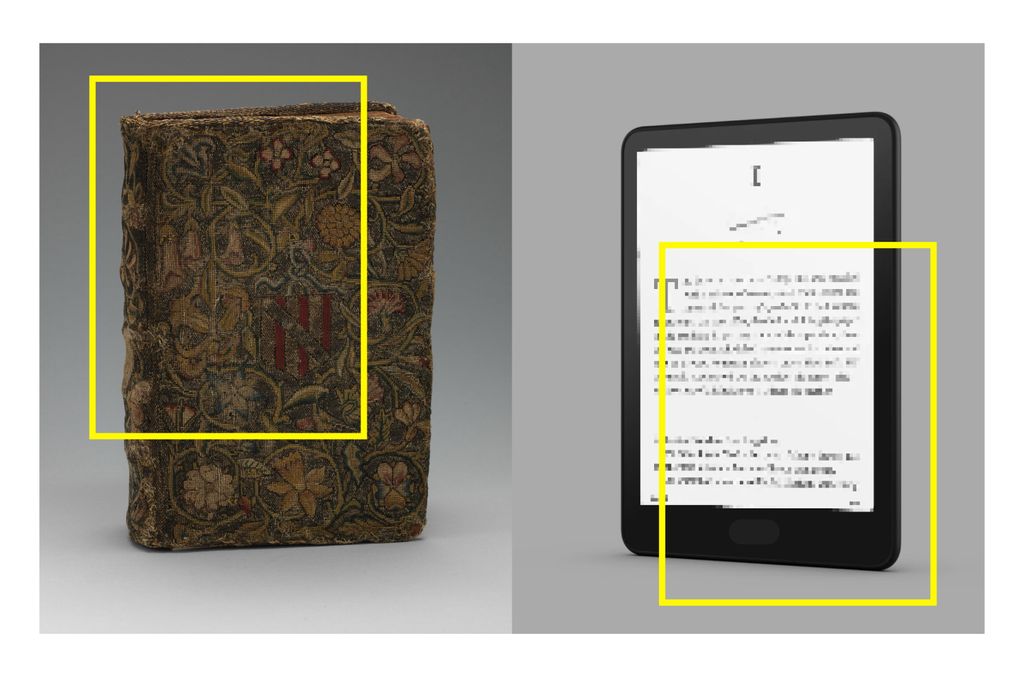
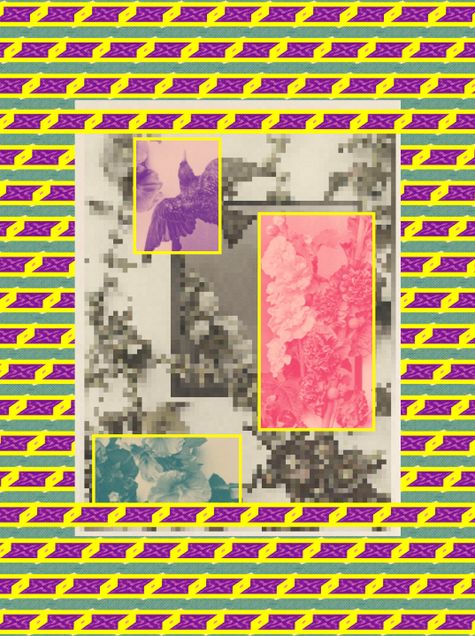
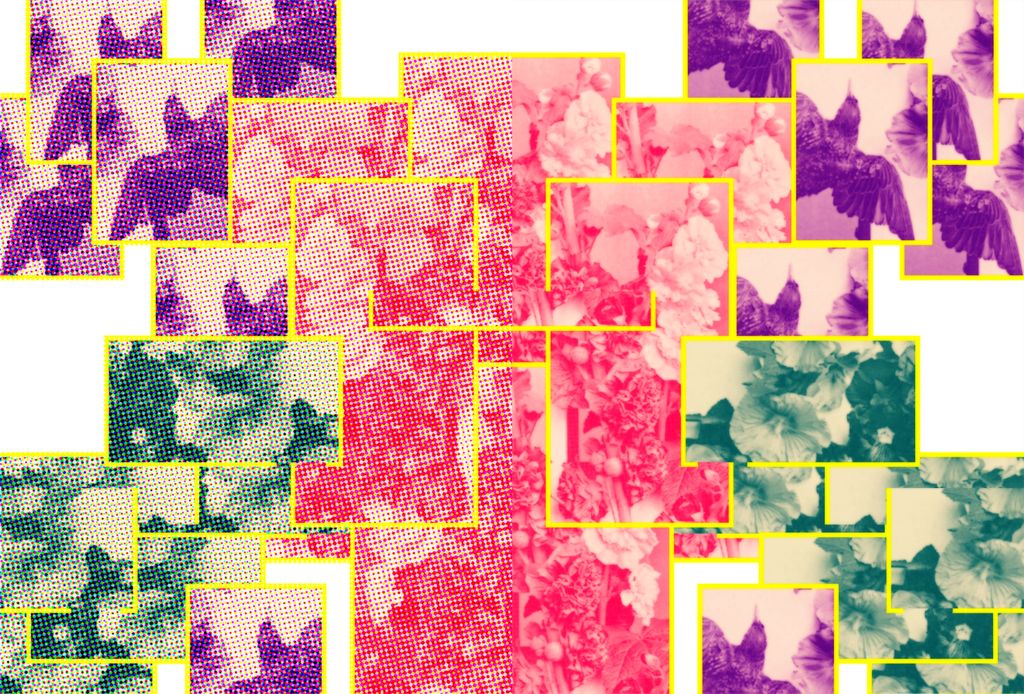
Figures 1-3. Elise Racine. A Book by Any Other Name (2024), Folio Fragments (2024), and Field Guide Distortions (2024). Digital collages involving archival images, photography, digital art, and artist-generated annotations.
A Book by Any Other Name (fig. 1) juxtaposes a weathered physical tome with its digital counterpart, highlighting how artificial intelligence reinterprets the essence of “book-ness.” The textured, ornate cover of the book—a Bible from ca. 1602—stands in stark contrast to the sleek, minimalist e-reader interface. Still, both objects serve as vessels for human knowledge and demand their own form of tactile engagement. The artist-generated yellow frames mimic the bounding boxes used in AI object detection. The accompanying annotations reveal how algorithms “see” and interpret visual information, highlighting elements the system identifies as significant. The boxes have the added benefit of drawing attention to how our eyes and fingers must navigate differently across these surfaces. Here we engage with the tension between physical and digital tactility—between the controlled, bounded experience of turning a page and the potentially endless scroll of digital content.
Meanwhile, Folio Fragments and Field Guide Distortions (figs. 2-3) employ fragmented compositions to further examine how digital media disrupts traditional ways of organizing and accessing information. Building again on the pattern of AI annotations, these pieces feature yellow boxes that highlight the tension between machine and human interpretation. The geometric abstraction framing the original archival image in Folio Fragments causes new details and patterns to emerge. In Field Guide Distortions, this effect is captured by AI annotation boxes whose contents and borders dissolve into pixels and halftone displays, further blurring the distinction between digital and analog representation. As vibrant colors bleed across these boundaries, the image becomes a metaphor for the chaos and the creativity inherent in digital knowledge systems.
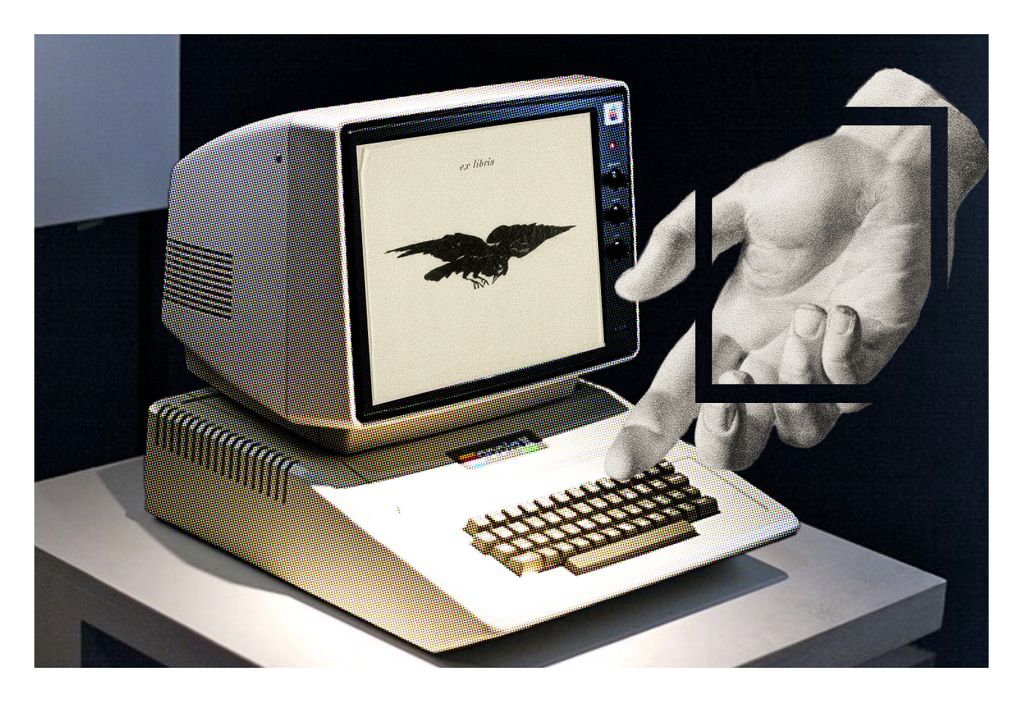
Figure 4. Elise Racine. [Crow]dsourced (2024). Digital collage involving archival images, photography, and digital art.
By placing a traditional ex libris crow within the frame of an early personal computer, [Crow]dsourced (fig. 4) reflects on the shift from individual, physical possession to shared, digital knowledge generation. Historically a mark of ownership, the ex libris bookplate is recontextualized in an era of collective authorship and the crow, long symbolic of intelligence and memory, suggests our enduring drive to gather and share knowledge, even as the means of doing so evolve. Meanwhile, the fragmented hand in the corner speaks to the intimate gestures, or human “touch,” that persist in these virtual spaces and the collaborative nature of such acts.
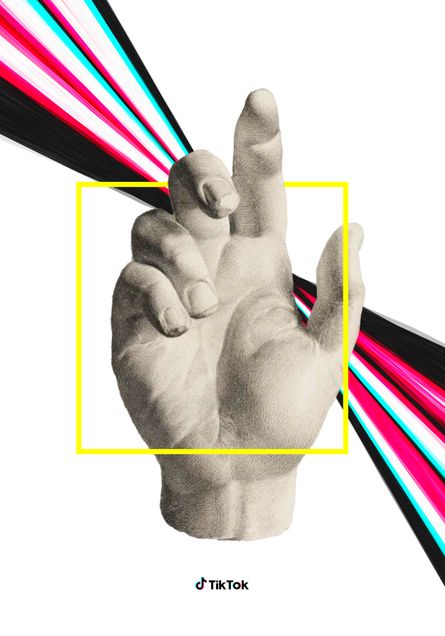
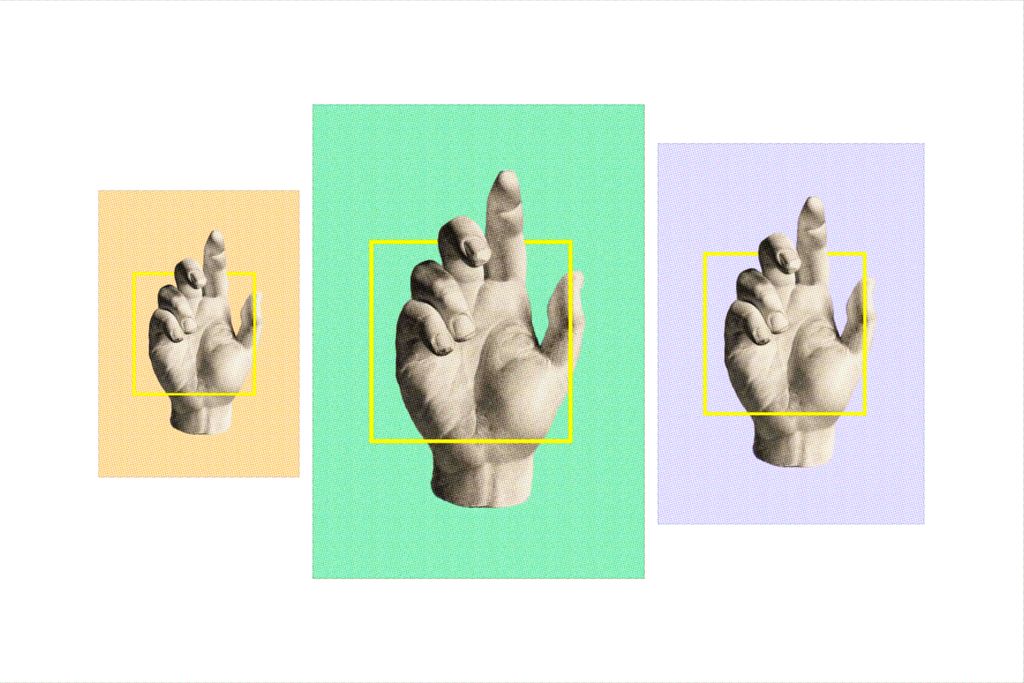
Figures 5-6. Elise Racine. At the Altar (2024) and Holy Trinity (2024). Digital collages involving archival images, digital art, and artist-generated annotations.
In At the Altar and Holy Trinity (figs. 5-6), we again see the hand. Originally a symbol of religious iconography, it now also mirrors the anatomical positions for scrolling, swiping, and liking. These actions—scroll, swipe, like—form a modern “holy trinity.” While digital interfaces may seem to distance us from the materiality of knowledge, we must also consider how they create new forms of sensory engagement, ones that merge historical devotional gestures with contemporary, technologically mediated rituals.
Figure 7. Elise Racine. On Loop (2024). Video art playing on an infinite loop.
On Loop and Scroll A(n)d Infinitum (figs. 7-8), extend this exploration, particularly the destabilizing, distortive nature of digital consumption, with motion and sound. Both were previously on view as Infinite Objects video prints in Boundless: An Exhibition of Book Art hosted by the Arts Galleries at the Peddie School in New Jersey.1
On Loop captures TikTok as a contemporary vessel for knowledge-sharing, pairing the hypnotic feed with an audio soundscape of clicks and taps. Through its fragmented structure, the piece mirrors how our attention splinters across infinite content streams. Scroll A(n)d Infinitum critiques the infinite scroll as a digital reading experience by featuring a long-form article endlessly looping, with glitch aesthetics and chromatic aberrations visualizing the sensory overload of contemporary interfaces. As text fragments blur and degrade, nearly reduced to a binary code of 1s and 0s, the piece highlights how machines can now “read” these digital texts even as they become illegible to human eyes. With the rise of Large Language Models, it poses the question of whether we are creating digital content not just for human consumption, but for an emerging audience of artificial readers—algorithms that process and interpret our knowledge in ways fundamentally different from human cognition.
These moments of friction are precisely why the relationship between physical books and digital interfaces is so compelling. This goes beyond how our fingers engage differently with each medium to how we navigate and control our progression through content and how these sensory interactions shape our reading experience. I strive to recreate the sensation of “doomscrolling,” a phenomenon that arises from the absence of natural endpoints that we find in traditional reading material. The slight discomfort or disorientation viewers might experience navigating this essay points to our larger cultural moment of adjustment to these evolving forms of knowledge transmission.
This work invites viewers to consider not just how we read and learn in the digital age, but how these new practices reshape our fundamental relationship with knowledge—at once more immediate and more mediated, more accessible and more fragmented, more tactile and more ephemeral. Perhaps most striking is how contemporary knowledge is simultaneously in a perpetual state of transition yet immortalized in the digital ether—forming new archives that train the next generation of machines.
Figure 8. Elise Racine. Scroll A(n)d Infinitum (2024). Video art playing on an infinite loop.
____________________
Elise Racine is a Washington, DC-based multidisciplinary activist, emerging artist, and PhD candidate at the University of Oxford. Using arts-based methodologies, her research examines the socio-ethical implications of emerging technologies, like artificial intelligence. Recent exhibitions include: The Bigger Picture (Beta Festival 2024, Ireland) and Unearthing (Sims Contemporary, NYC).
____________________
1. Infinite Objects are freestanding displays housed in acrylic that permanently loop one video. They can be picked up and handled, allowing viewers to physically engage with otherwise ephemeral digital media. In other words, they make the ephemeral tangible again.
Multisensory Experiences in Thomas Jefferson’s Plantations
by Mya Rose Bailey
I first heard the ringing of the Great Clock at Monticello in the dead of summer. The deep, steady resonance of the gong felt as though it could wipe the sweat from my back. I stared as its hammer, now muffled but still deafening in its strike, emanated three low reverberations. And then my three o’clock tour began. I was brought to Monticello by my Master’s thesis, which was concerned with how time and sound were constructed in two of Thomas Jefferson’s plantations in efforts to control Black enslaved labor. By exploring the sensory experience of enslavement through material culture and decorative arts, there is an opportunity to mentally deconstruct objects designed to present unnatural systems—such as race-based enslavement—as intrinsic and necessary to eighteenth- and nineteenth-century life.
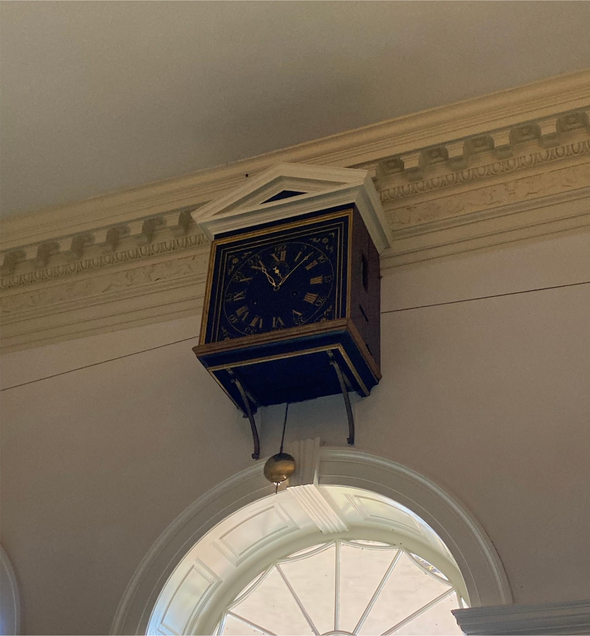
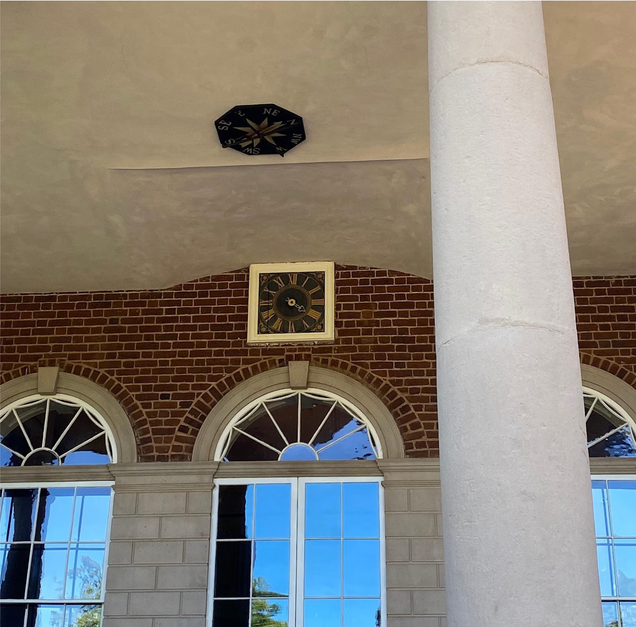
Designed by President and enslaver Thomas Jefferson, the Great Clock still stands, as it did for Antebellum audiences, as a marvel of Jefferson’s ingenuity and creativity. Its wooden double-faced body serves as a daily point of reference for internal and external viewers. Once allowed inside Monticello, audiences of the Great Clock can determine the exact time of day through a visible hour, minute, and second hand (fig. 1). Outdoor witnesses, however, only see a single hour hand on the clock’s exterior face (fig. 2). The Chinese gong housed on the roof of Monticello chimes the corresponding hour, reverberating across six miles of the plantation, according to Peter Fossett, one of the nearly six hundred Black people Jefferson enslaved in his lifetime.1
The gong sonically enforced a schedule of labor that could be heard and followed voluntarily by anyone present but was involuntarily heeded by the enslaved community. A constant awareness of the gong’s count signaled when a day’s work began at dawn and ended at dusk, as well as breaks for meals, curfews, and allotted “free” time.2
Monticello in Charlottesville, Virginia and Poplar Forest in Bedford County, Virginia were Jefferson’s most prominent homes and plantations, with a combined ten thousand acres of farmland and nearly two hundred people at a time enslaved across both. To aid in managing this scale of property, Jefferson designed, deployed, and depended heavily on time-keeping and time-telling devices to organize and communicate work schedules to all present laborers.3 Time-telling is best exemplified by objects such as the Great Clock, as its grandeur, permanence, and immovability demand recognition as the standard of regulation in its positioned environment. Multiple case and shelf clocks were also present in more intimate settings for enslaved laborers, specifically the kitchens at both Monticello and Poplar Forest.4 The striking difference between the timekeeping devices’ scale in these spaces suggests the ability of clocks to oversee the bodies, acting as tools of regulation as opposed to entertainment. In contrast to the Great Clock—which would have both delighted and fascinated free visitors to Monticello—these small clocks governed and maintained enslaved bodies and their labor.
One can imagine the rhythmic ticking of a shelf or case clock within the soundscape of a kitchen often occupied by a single cook. The Jefferson family would have set expectations for when a meal should be served, as signalled by the swinging of a hammer chime. Such meals — which would have been made countless times by Monticello cooks — were created both through embodied knowledge and alternative modes of timekeeping (song, prayer, etc.)
This request for a prepared meal at Poplar Forest was commanded by a single brass bell rung by Jefferson that was later excavated from Poplar Forest’s main house.5 The disembodiment of these sounds, and the labor Jefferson demanded through them, is essential in understanding how linear perceptions of time and constructed soundscapes were presented as intrinsic to the hundreds of people he enslaved.
Jefferson’s own understanding of time as both linear and irretrievable was largely informed by European philosophers within the Age of Enlightenment and cultivated his disdain for idleness.6 Jefferson’s subsequent compulsion for efficiency manifested in strict schedules for himself, his family, and the people he enslaved. This temporal imposition was likely disorienting due to the fact that in the Bight of Biafra, where most of his enslaved laborers were taken from in the eighteenth century, time was regarded as unregulated and multidirectional.7 This encourages us—in the contemporary moment—to reconsider the ways enslaved people may have measured, felt, and sounded time within a day. Most importantly, it begs a reconsideration of how we and Jefferson expect time and the sensorium to function for enslaved people. Jefferson himself noted the vibrancy of music and nightlife of those he enslaved in his only full-length book, Notes on the State of Virginia, stating “a black, after hard labour through the day, will be induced by the slightest amusements to sit up till midnight, or later, though knowing he must be out with the first dawn of the morning.”8 The presence of music—specifically music at night, away from the audible demands of labor—suggests another layered soundscape that was not only experienced communally amongst the enslaved but produced by and for themselves as well.
My approach to the sensory experience of enslavement rests upon the acknowledgement that Monticello, Poplar Forest, and the consequent soundscapes of these plantations are all, even loosely, predicated upon slavery in that they only exist because of and to maintain enslavement. Thus, in my interpretation of these constructed temporalities, landscapes, and soundscapes, it is critical to remember there is nothing natural about enslavement. This notion extends to the devices used to both organize and naturalize its practice. Utilizing the senses, especially sound, as both a mode and subject of study permits a more complete picture of the conditions of slavery, both in the ability to place ourselves in the physical landscape of enslaved people and to deconstruct social, cultural, and physical systems that have aided in the dehumanization of enslaved people.
____________________
Mya Rose Bailey (they/she) is an Afro-Caribbean scholar interested in multisensory anthropology, temporality, and memory in Black history and culture. They hold a BA in Art History from SUNY New Paltz and are currently completing their MA in Decorative Arts, Design History, and Material Culture from Bard Graduate Center.
____________________
1. Thomas Jefferson’s Monticello, “Behind the Scenes: Conservation of Jefferson’s Great Clock,” YouTube, 2021. 5:18–5:31, https://youtu.be/c14pjuikHRs?si=JYXg9x-niaLcgaKv.
2. Karen E. McIlvoy, “Traces of Jefferson’s Time at Poplar Forest,” Poplar Forest Archaeology Blog, April 7, 2017, https://www.poplarforest.org/traces-jeffersons-time-poplar-forest/.
3. Art Historian Wu Hung differentiates between time-keeping and time-telling, noting “[t]ime keeping relies on horology and astronomy that allowed governing bodies to regulate seasons, months, days, and hours,” while “[t]ime telling conveys a standardized conventional time to a large, general public.” Wu Hung, “Monumentality of Time: Giant Clocks, the Drum Tower, the Clock Tower,” Monuments and Memory, Made and Unmade, ed. Robert S. Nelson and Margaret Rose Olin (University of Chicago Press, 2003), 108.
4. McIlvoy, “Traces of Jefferson’s Time at Poplar Forest.”
5. “Servant Bells at Poplar Forest,” Poplar Forest Archaeology Blog, February 4, 2016, https://www.poplarforest.org/servant-bells-at-poplar-forest/.
6. McIlvoy, “Traces of Jefferson’s Time at Poplar Forest.”
7. McIlvoy, “Traces of Jefferson’s Time at Poplar Forest.”
8. Thomas Jefferson, Notes on the State of Virginia (University of North Carolina at Chapel Hill Libraries, 2006), 139, https://docsouth.unc.edu/southlit/jefferson/jefferson.html.
Conjuring the Spirit World
Peabody Essex Museum
September 14, 2024–February 2, 2025
by Angelina Diamante
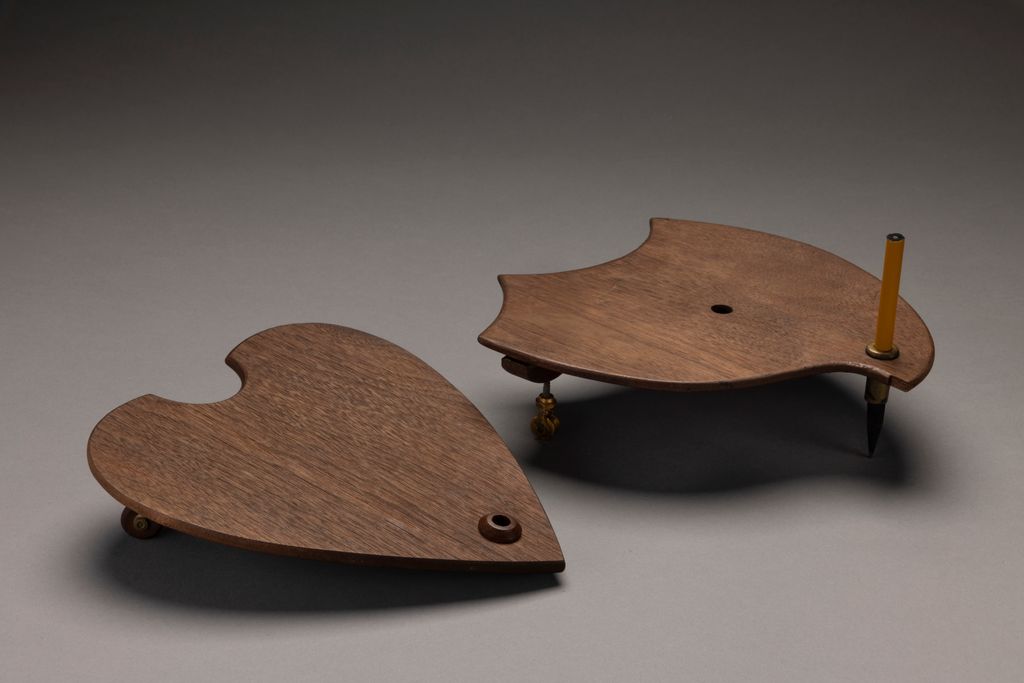
A sincere recognition of the ephemera spanning nearly a century that defines Conjuring the Spirit World: Art, Magic, and Mediums—a five-month-long survey of Spiritualism at the Peabody Essex Museum of Salem, Massachusetts—requires a deliberate surrender to nonnormative faculty: in essence, a sixth sense. Composed of an array of posters, projections, photographs, paintings, illusions, film fragments, sculptures, advertisements, and apparatuses, the exhibition’s artifacts incite an active engagement of all the senses, diminishing the boundaries between them and prompting a reconsideration of the very nature of perception.
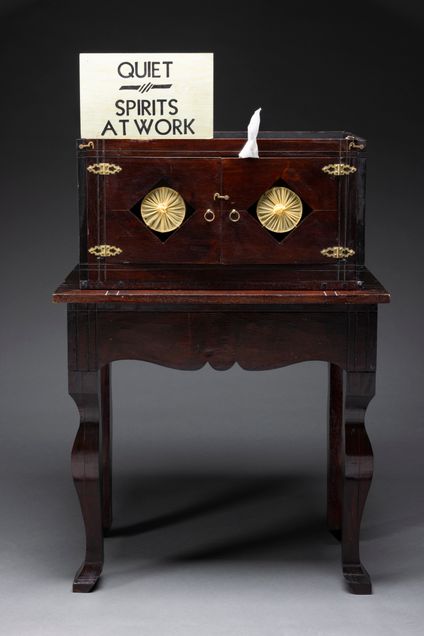
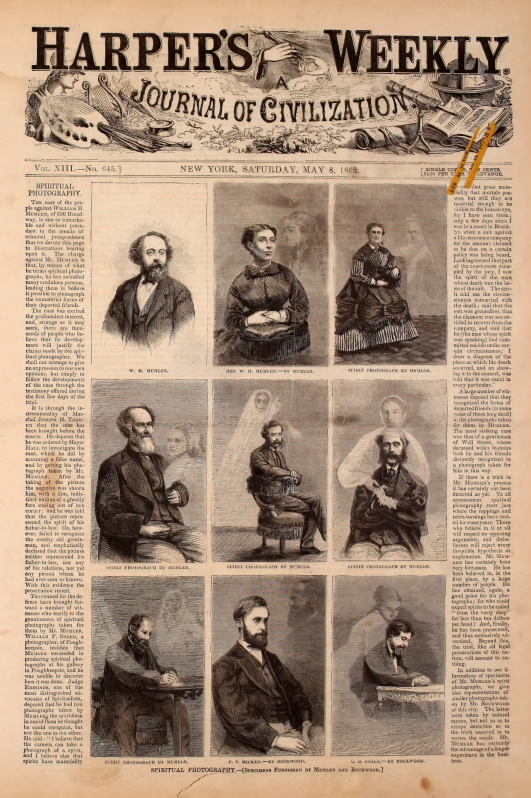
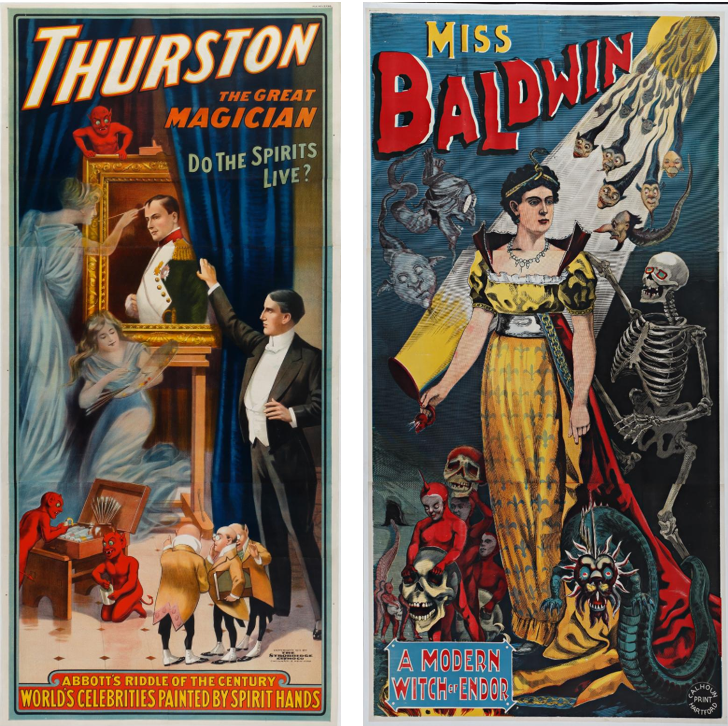
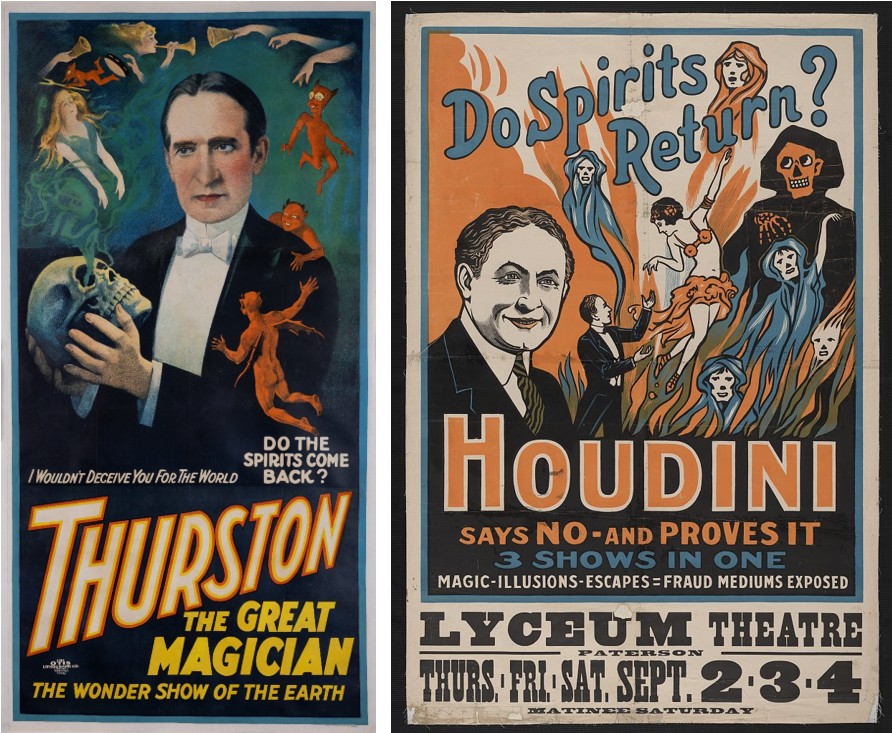
In addition to evoking clairvoyance in its most fundamental form, this new sense possesses a duality; through the inciting of a historical prescience of sorts, transportation to a past world that engaged magicians and mediums alike is viable. Thus, viewers become vessels for transmuting the sensuous perceptions of visual culture of the nineteenth-and-twentieth-century Spiritualism movement in the modern day. Integral to this effect is the exhibition’s reliance on an array of bold, large-scale magician advertisement broadsides; what were once instrumental in destabilizing the periphery between the spectral realm and the early-twentieth-century psyche now grant contemporary viewers insight into a world where belief was fundamental. The vibrant Do Spirits Live? (fig. 4), promoting the spirit paintings of magician Howard Thurston, and the striking Miss Baldwin, a Modern Witch of Endor (fig. 5), featuring female clairvoyant Kitty Baldwin, epitomize the visual and textual iconography of Spiritualism in popular consciousness. Perhaps all the more imploring are those advertisements that offer a contrary perspective; while the exhibition’s 1929 centerpiece—a poster of Thurston clutching a skull (fig. 6)—boldly asks, “DO THE SPIRITS COME BACK?”, a 1909 print featuring a smirking Harry Houdini presents a stern rebuttal: “HOUDINI SAYS NO - AND PROVES IT” (fig. 7). This juxtaposition underscores the intricacies and partitions within a culture often retroactively regarded as one-dimensional, thereby challenging modern assumptions by revealing the ways in which reality and spectacle harmonized with the senses, achieving resolution with audiences of the present.
As George H. Schwartz, the PEM’s Curator-at-Large, states, “belief is at the core of [the exhibition],” affirming the psychic sentiment behind Conjuring the Spirit World. By interrogating the complex mechanics of perception and identity, this exhibition implores viewers to strive beyond a passive observation: not only through a sensorial engagement with the enchanting objects at hand or a retrospective regard for the Spiritualism movement, but, more crucially, through a critical reexamination of the broader implications of belief in understanding the modern world.
____________________
Angelina Diamante is an MA candidate at Sotheby’s Institute of Art (Valedictorian, with distinction) and a specialist in Italian Renaissance and Baroque European painting and sculpture. Recently, her research has considered art and its intersection with the esoteric and occult, evincing motifs such as classical paganism and the Gothic.
____________________
From Perfume to Smoke: Transforming Salubrious Scents in a Renaissance Perfume Burner
by Madison Clyburn
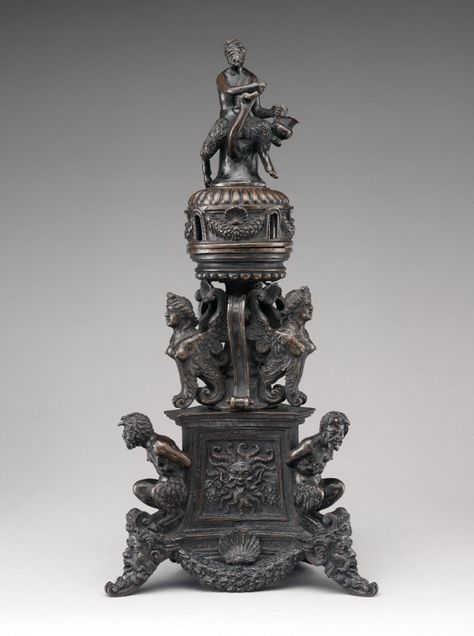
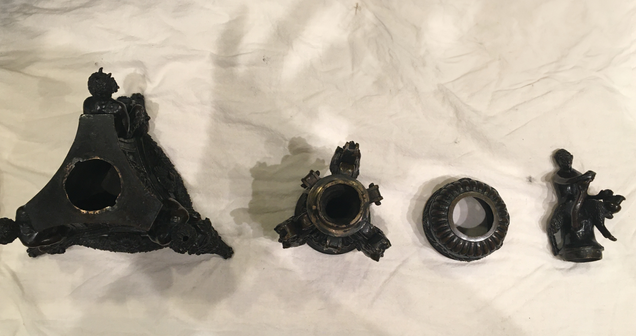
A classically inspired bronze incense burner from a Paduan workshop, now in the Metropolitan Museum of Art in New York City, speaks to the multi-sensory meditations that once occurred in an early modern Italian home (fig. 1).1 This particular incense burner measures just over a foot tall, is pyramidal in shape, and is comprised of four different parts: base, central column, drum, and finial (fig. 2).2
Like rising perfumed smoke, the decoration is aligned vertically and its fantastical satyrs, sphinxes, grotesque masks, and scalloped shells invoke Bacchic theatricality. The incense burner’s form and iconography derive from the famed Italian sculptor Andrea Riccio’s (ca. 1470–1532) humanistically informed Paschal Candelabrum (1507–16), made for the Basilica of Saint Anthony in Padua.3 Such erudite iconography was popular in Padua—a city celebrated in the sixteenth century for its humanist culture, bronze production, and medical university.
The transformation of a solid perfume into smoke through the application of fire had a multi-dimensional effect on the Renaissance home and body. In the early modern period, scented air was critical to maintaining good health; the affective, ephemeral substance, infused with the divine power of plants, drifted through city streets and infiltrated domestic halls and bodies, influencing the health of those living in Padua.4 Today, this incense burner is admired solely as an art object, devoid of its once fragrant social life. Centuries earlier, though, one would likely find it in a home, infusing a camera (multipurpose bedroom) or studiolo (study) with salubrious scents.5 Within such a space, the Renaissance user would place dried perfume (sticks or pastilles) in the incense burner’s internal compartment or external apertures and set them aflame. The resulting embers would subsequently release energizing swirls of aromatic smoke while tossing delicate light across the bronze surface, encouraging the scholar to meditate on the dramatic transformation unfolding before them. This once-fragrant object—truly a feast for the senses—exemplifies the Renaissance humanist’s philosophical interests, urban lifestyle, and desire for good health.
The New York incense burner’s iconographic pattern mirrors the humanist antiquarian’s interest in the philological and archaeological evidence of the classical past.6 From the bound and rugged satyrs to the wise and alluring sphinxes, these creatures blur the line between coarse animal and cultivated human, philosophically questioning an individual’s true nature.7 The hybrid imagery encourages the owner’s contemplation of the concept of transformation—an idea made vividly real by the metamorphizing act of burning a solid pastille or incense stick into smoke. The transient, sweet-smelling vapor that would curl up and around the burner, together with the object’s iconographical design, conjure a multi-sensorial fantasy appealing to upper-class consumers residing in sixteenth-century Padua.8
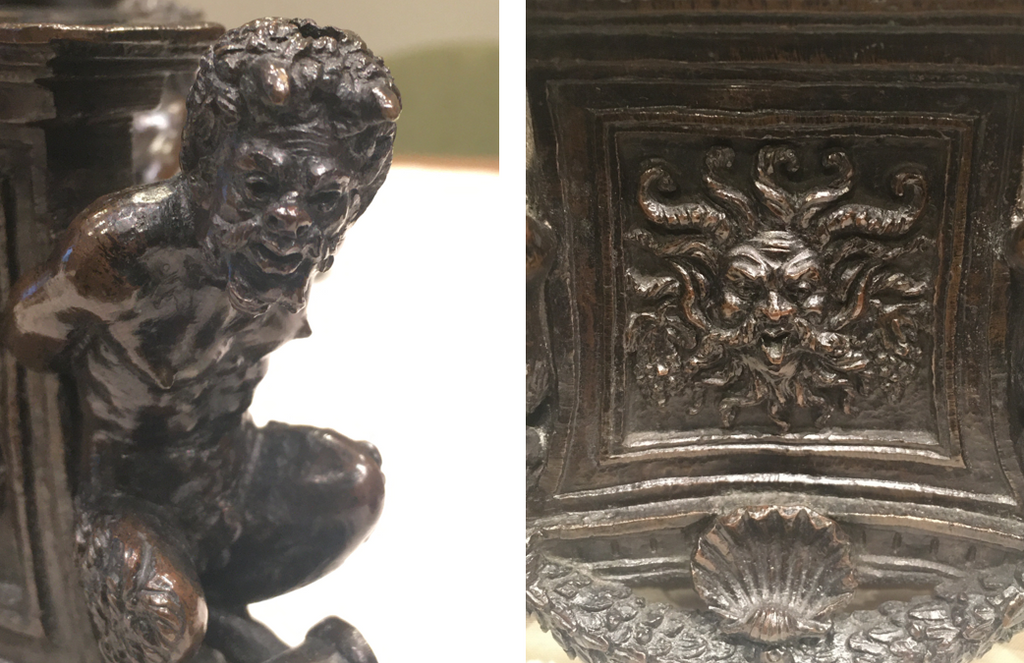
Attached to the corners of the base are feet made from satyr masks surmounted by a bound satyr (fig. 3). In his Sileni of Alcibiades (1515), the Dutch humanist Erasmus (ca. 1468?–1536) deviates from the satyr’s classical association with lust and mischief.9 Instead, he argues that if the satyr Silenus is “opened,” that is, his divinely interior self is unbound, he reveals his “great and lofty spirit worthy of a true philosopher.”10 Three decorative plaques alternate between the satyrs’ bound spirits; each one depicts a classicizing Bacchic mask with deeply set forehead wrinkles, wild, twisting hair, and a curled tongue flanked by bunches of grapes, signaling its relation to the fantastical concept of the grotesque (fig. 4).11 Meanwhile, the bordering fruit marks the transformation of grapes to wine but also from sobriety to drunkenness.12 This transition allows one to access the permeable state of divine “madness,” described by the priest and Neoplatonist philosopher Marsilio Ficino (1433–99).13 In his commentary on Plato’s Symposium titled De amore (On Love; 1469), he meditates on the soul’s continuous rise and fall through four states: Intellect, Reason, Opinion, and Nature. Bacchus’s drunkenness, and by extension, the Renaissance humanist’s intellectual inebriation activated through meditation on the smoldering incense burner, simultaneously draws the scholar to the lower world of the senses—smell, taste, and touch—and the higher world of the mind.14 In this revelatory state, inspired by Neoplatonic philosophy, the humanist’s cerebral drunkenness illuminates his rational soul, allowing him to perceive God more closely.15
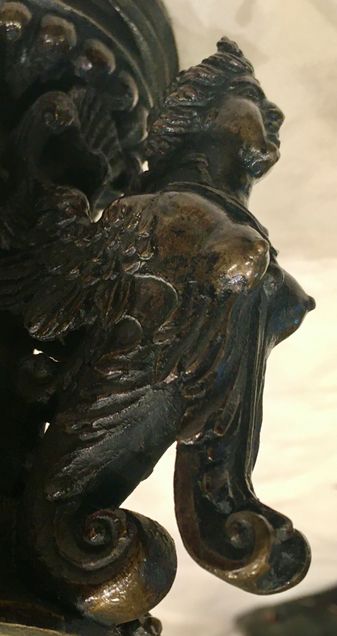
Attached to the central column are a triad of alternating volutes and winged sphinxes—classical symbols of wisdom and death—with a scalloped shell nestled between their wingtips.16 The figures recall the sphinx from the ancient Greek tragedian Sophocles’s Oedipus Rex.17 Each female hybrid’s scrolled feet unfurl into lion’s fur incised on the base and torso as lusciously layered, feathered bird wings taper into the bust and head of a woman (fig. 5).
In Renaissance architectural style, sphinxes often merge architectural forms with female bodies. In this case, the sphinxes’ lion paws are transformed into miniature volutes. Together with the full-size volutes, they figuratively support the pierced, gadrooned drum above.The third tier features a series of arched windows that allow fragrant smoke to pass through. Laurel festoons fill the space between each opening, topped in the middle with scalloped shells—classical and Christian symbols indicative of transformation and rebirth.18 Like the Greek sphinx, who challenges those she meets to a riddle on the transformation of human life, the symbolic shell may also signal the owner’s mystical journey.
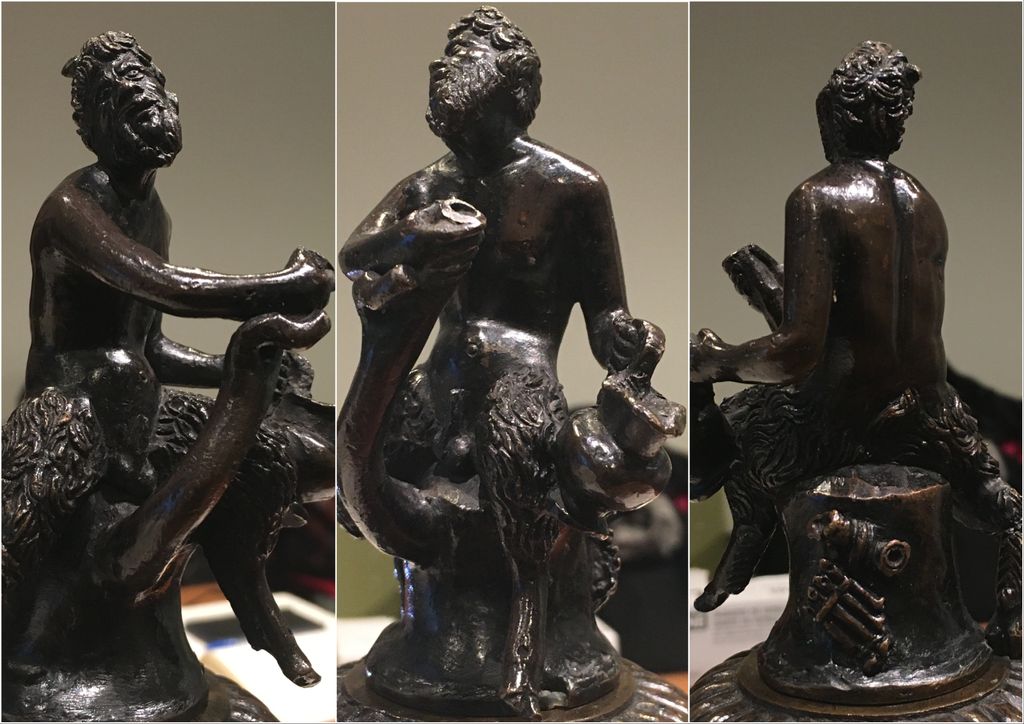
The top of the incense burner showcases a finial in the form of a satyr whose relaxed posture, vacant expression, pitcher of wine, and discarded panpipes suggest the drunken revelry of Dionysus or Pan (fig. 6). However, the satyr’s soft and elongated limbs, distinctive from those of the energetic and tightly bound satyrs at the base of the burner, suggest that this finial was made separately and added later.19 The original finial is likely a statuette of a satyr and satyress copulating like that found on a sixteenth-century Paduan inkwell cover (fig. 7).
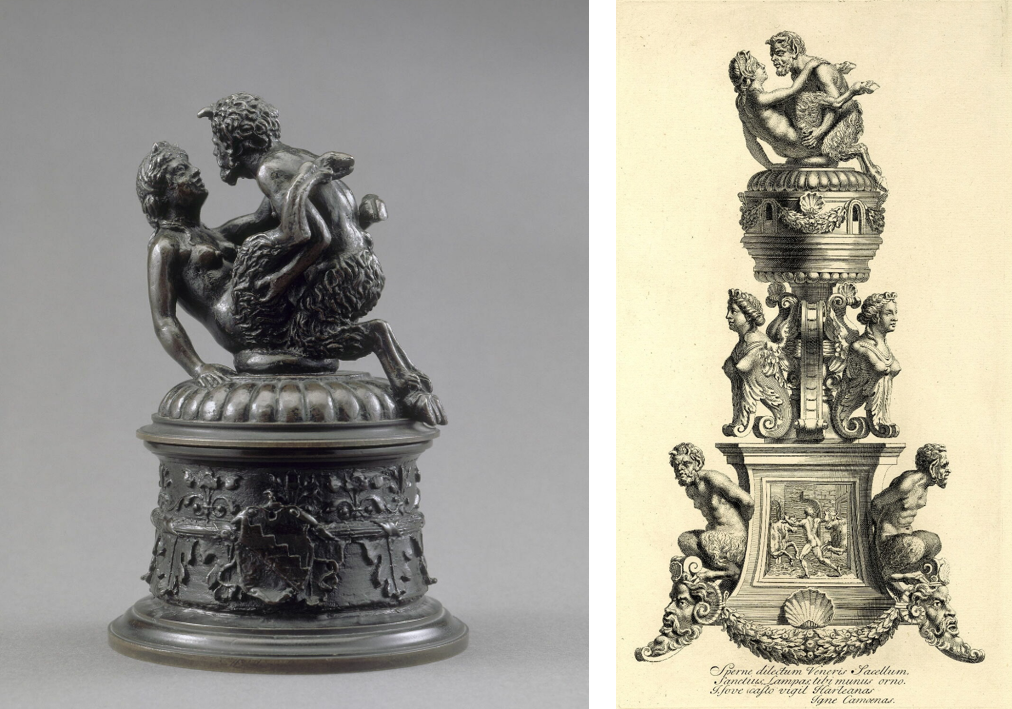
An eighteenth-century illustration of a Paduan pyramidal perfume burner (fig. 8) from the same workshop as the New York incense burner helps us imagine its original esoteric theatricality.20 The initial finial suggests the humanist scholar’s interest in philosophy and the cathartic transformation from the captive body to the unbound soul and its harmony with nature, or simply a taste for the erotic in a period saturated with amorous images of satyrs and satyresses in pastoral settings.21
Once burned, the intoxicating and energizing aroma of agarwood, benzoin, cedar, and clove-scented pastilles or sticks would waft up from the perforated heads of the bound satyrs and rising sphinxes (fig. 9) and out of the dome’s arched windows to envelope the satyrs atop the burner. The scented air continues upward, past the ambiguous but symbolically loaded finial, and up to God or a higher principle.
We must imagine—as historical audiences would have understood—the scented air eventually permeating the humanist’s porous body, sitting nearby. After entering the body, the aromatic molecules course through the scholar’s arteries and travel to the brain and heart. In doing so, scented air, facilitated through the use of a perfume burner, infuses the individual’s pneuma (air or life force) with salubrious scents to nurture the soul.22
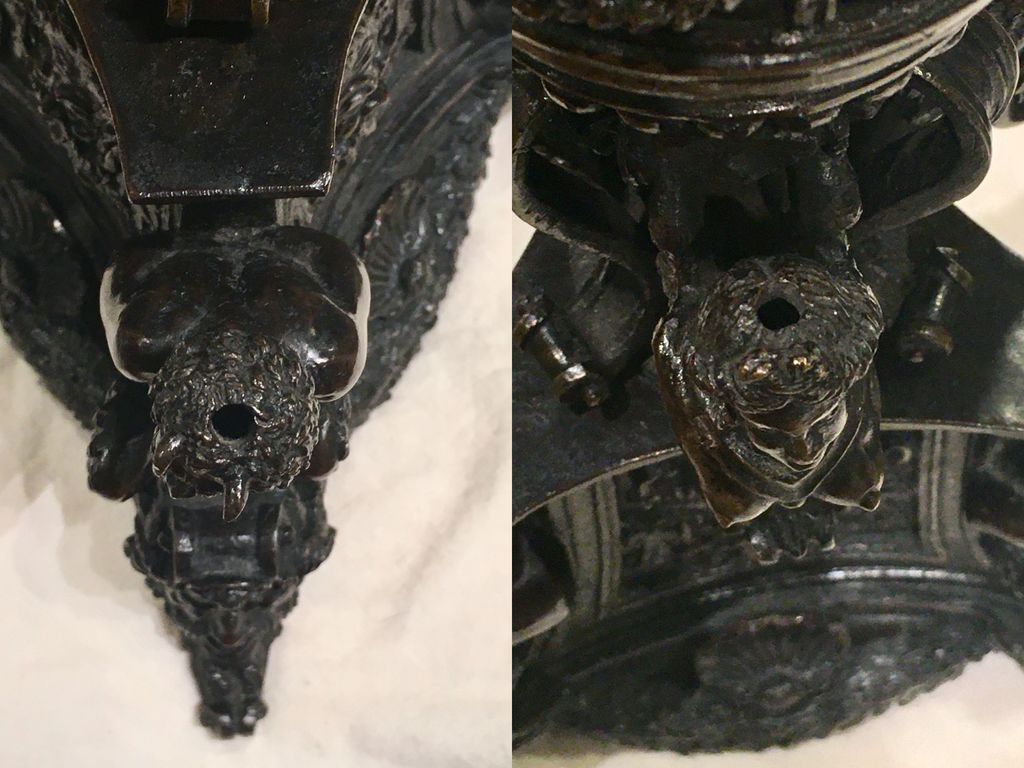
The sixteenth-century Paduan would have been cognizant of the stimulating, therapeutic effects of scent in a city teeming with students, pilgrims, rubbish, disease, and fragrant imports. Academic and economic influences from Venice and the Levant contributed to Padua’s olfactive mindfulness during this time. When our unknown maker fabricated the New York incense burner, the University of Padua (founded in 1222) was already internationally renowned as a center for medical innovation. Andrea Vesalius’s (1514–64) anatomical text, De humani corporis fabrica (1542), corresponds with the Professor of Practical Medicine, Giovanni Battista da Monte’s (1489–1551) hands-on clinical teaching and the 1595 opening of the first permanent anatomical theatre.23 In 1545, the Venetian Republic founded the first teaching botanical garden for students enrolled at the University of Padua (fig. 10).24 In this erudite atmosphere, professors combined theory and practice using translated ancient Greco-Roman and medieval Islamic texts by Aristotle, Galen, and Avicenna and specimens from the University’s botanical garden to teach about the transformative power of therapeutic scents.
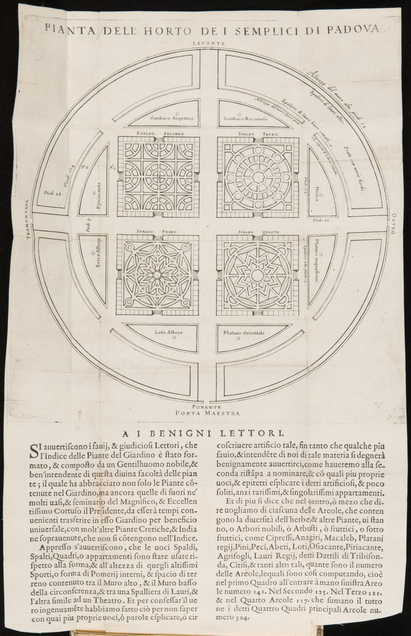
Knowledge of perfumed medicines reached Padua primarily through the Republic of Venice, given its political control of the city since 1404.25 Venice—a cosmopolitan maritime center that thrived on trade relationships with Levantine mercantile partners—imported a variety of aromatics such as aloeswood, musk, civet, and ambergris from Egypt, Syria, Lebanon, and Cyprus.26 These substances were transported to nearby Padua for distribution to various institutions and vendors, allowing students and long-term residents to purchase ready-made perfumed pastilles, pastes, waters, and oils and “simples” (single ingredients) to create perfumes at home using tried-and-true recipes. A genre of books called Libri di Secreti (Books of Secrets) provided many perfume recipes to use in an incense burner, such as ones “to make a fragrant perfume to scent the house” and a “moist perfume for the room.”27 Both recipes from Giovanventura Rosetti’s Notandissimi secreti de l’arte profumatoria incorporate fragrant ingredients admired for their medicinal properties, including rosewater, aloeswood, olibanum, styrax, cloves, sandalwood, and cedar. Many recipes never made it to the printing press but existed in household manuscripts. Recipes for “soft perfumes in pans to scent rooms,” “perfumes to burn in ten ways,” and a “very noble room perfume” indicate ways to burn inspiring, transportive, salutary scents in domestic spaces.28
Surrounding oneself with sweet-smelling air was critical to maintaining or correcting one’s health—physically, spiritually, and mentally. The fortifying properties imbued in the air also played a crucial role in creating healthy, protective, and pleasant homes. The New York incense burner invites us to consider its placement among other coveted but ephemeral aromatic goods made of fragrant plant and animal-based substances complete with “personal, cultural, and social meaning” used to beautify and sanitize upper-middle-class Italian homes in the early modern period.29 For example, perfumed pastilles sheltered in bed warmers encouraged soothing sleeping quarters; floral-scented powders sewn into pillows placed on one’s lap while sewing transported them to fields of roses; while a pungent, disinfectant mix of pitch, styrax, and myrrh scrubbed over walls and floors secured dwellings against infectious air.30 Such perfumed mixtures act as transformative intermediaries capable of offering pleasure and protection. Considering this, the owner of the New York incense burner might set alight aromatic pastilles or sticks for a myriad of reasons, such as tempering the air, regulating the bodily humours, energizing the brain, fortifying the heart, stimulating sex organs, and meditating on metaphysical questions.31
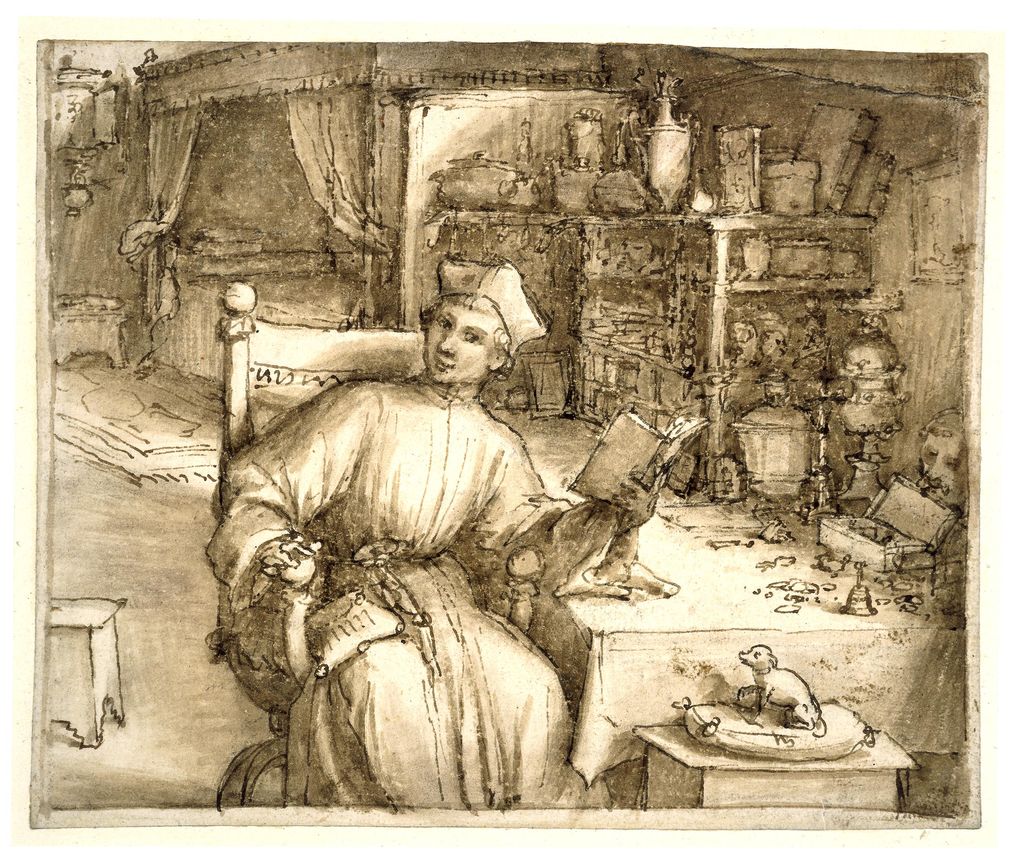
Suppose we imagine a humanist scholar, like this ecclesiastic (fig. 11), sitting in his study, surrounded by books and antiquities, contemplating the philosophical text in his hand while some spiritual imbalance unsettles his humors.32 In that case, the incense burner’s presence on a shelf or desktop speaks to the myriad transformative abilities of perfume. Emblematic of a thriving academic community’s interest in wellness, sixteenth-century Paduan incense burners reflect a sensorial appreciation for tactile delights and tasteful homes mediated through perfumed air.
____________________
Madison Clyburn is an Art History PhD Candidate at McGill University. Her work focuses on medicinal perfumes and the material culture of women’s wellness in late medieval and early modern Italy. She has written for The Recipes Project, Ornamentum magazine, and the SSHRC-funded project Hidden Hands in Colonial Natural Histories.
____________________
1. Unless otherwise indicated, translations are the author’s.
The burner’s manufacture from a wax sculpture to its bronze casting is loosely attributed to Desiderio da Firenze (active Padua, 1532–45), who worked in the Veneto around the time of its creation, or an unknown Paduan workshop. Twelve variations of pyramidal and drum perfume burners produced in this Paduan workshop are located in the Metropolitan Museum of Art (invs. 41.100.78a-d and 1982.60.108); National Gallery of Art, Washington D.C. (unknown inv. number and inv. 1942.9.140); the Wallace Collection (S66); the Victoria and Albert Museum (M.677-1910); the Rijksmuseum (BK-1957-3); the Louvre (OA.7406, .8256); and the Herzog Anton Ulrich Museum, Braunschweig (unknown inv. number). Drum burners are found in the Metropolitan Museum of Art (invs. 1975.1.1396 and 1975.1.1397) and the Ashmolean Museum (WA2004.1).
2. I do not address the incense burner’s casting technique in this essay. For an analysis of the New York incense burner’s casting technique, see Madison Clyburn, Department of European Sculpture and Decorative Arts Object File (ESDA/OF), the Metropolitan Museum of Art—a study I wrote in a Bard Graduate Center seminar on bronzes held at the the Met and taught by Denise Allen, Elyse Nelson, and Jeffrey Fraiman in Spring 2020.
3. Giovanni Battista de Leone (ca. 1480–1528), Niccolò Leonico Tomeo (1456–1531), and Livio Maggi da Bassano (active 1506)—three of the five Humanists who served as massari (presiding members) on the Council of the Arca del Santo—contributed to the Paschal Candelabrum’s iconographic program, which promoted complex theological and philosophical concepts. The Candelabrum was meant to mark the first light of Christ on Easter morning. Read philosophically, the candle’s flame is akin to divine light, which “illuminates the intelligence and kindles its innate appetite at the very moment when, moved by love, it turns to God.” See Davide Banzato, “Riccio’s Humanist Circle and the Paschal Candelabrum,” in Andrea Riccio: Renaissance Master of Bronze, eds. Denise Allen and Peta Motture (The Frick Collection, 2008), 41–45, 58. For an image of Riccio’s Candelabrum, see Web Gallery of Art, https://www.wga.hu/html_m/r/riccio/candelab.html.
4. According to the proto-feminist Venetian author, Moderata Fonte (1555–92), “…God has even thought to place these [assistive] powers in plants to aid us in our infirmities. How grateful we should be!” See Moderata Fonte, The Worth of Women, ed. and trans. Virginia Cox (The University of Chicago Press, 1997), 168 for the complete passage. On the importance of “healthy” air, see Sandra Cavallo and Tessa Storey, Healthy Living in Late Renaissance Italy (Oxford University Press, 2013), especially “Chapter 3: Worrying About Air,” 70–112.
5. The studiolo had many functions in sixteenth-century Italy: it was a room for reading, writing, introspection, sociability, business, and diplomacy but also a curated space that functioned as the “innermost secret chamber of an individual’s personal world”; see Chriscinda Henry, Playful Pictures: Art, Leisure, and Entertainment in the Venetian Renaissance Home (Penn State University Press, 2021), 43. On the relationship between an individual’s studiolo, their possessions, and mental stimulation, see Stephen Campbell, The Cabinet of Eros: Renaissance Mythological Painting and the Studiolo of Isabella d’Este (Yale University Press, 2004), 31–32.
6. Robert Weiss, The Renaissance Discovery of Classical Antiquity (Basil Blackwell, 1988), 59.
7. Jessica Hughes, “Dissecting the Classical Hybrid,” in Body Parts and Bodies Whole, eds. Katharina Rebay-Salisbury, Marie Louise Stig Sørensen, and Jessica Hughes (Oxbow Books, 2010), 109.
8. While many of these tabletop perfume burners were used in Northern Italian homes, international students and tourists from England, France, Germany, and Poland (to name a few locations) likely purchased similar burners to take back to their home countries. On the demand for small, luxury, utilitarian bronzes that decorated upper-class homes in sixteenth-century Italy, see Denise Allen and Peta Motture, eds., Andrea Riccio: Renaissance Master of Bronze (The Frick Collection, 2008) and Peta Motture, The Culture of Bronze: Making and Meaning in Italian Renaissance Sculpture (V&A Publishing, 2019).
9. Ovid offers a more traditional account of the satyr in his Metamorphoses, describing “old Silenus, drunk, unsteady on his staff; jolting so rough on his small back-bent ass,” amid a Bacchanal. Ov., Met. 4.1.
10. Italics mine. Erasmus, “Adages: 1 Sileni Alcibiadis / The Sileni of Alcibiades – 100 Intersecta musica / The music is cut off,” in Collected Works of Erasmus: Adages: II vii 1 to III iii 100, trans. R.A.B. Mynors (University of Toronto Press, 1992), 263. For the satyr’s various meanings in early modern humanist culture, see Anthony Parr, “Time and the Satyr,” Huntington Library Quarterly 68, no. 3 (2005): 451–53.
11. For an overview of the concept of the grotesque in early modern Italy, see Alessandra Zamperini, Ornament and the Grotesque: Fantastical Decoration from Antiquity to Art Nouveau (Thames & Hudson, 2008). On the metamorphizing aspect of the grotesque, see Luke Morgan, “The Grotesque and the Monstrous,” in The Monster in the Garden: The Grotesque and the Gigantic in Renaissance Landscape Design (University of Pennsylvania Press, 2016).
12. For Bacchus’s role in early modern philosophical conceptions of drunkenness, see Charles H. Carman, “Michelangelo’s ‘Bacchus’ and Divine Frenzy,” Notes in the History of Art 2, no. 4 (Summer 1983): 8, and Florence M. Weinberg, The Wine & the Will: Rabelais’s Bacchic Christianity (Wayne State University Press, 1972), 45–52.
13. Marsilio Ficino, Commentary on Plato’s Symposium on Love, trans. Sears Jayne (Spring Publications, 1985), 168–71.
14. The Italian humanist philosopher, Giovanni Pico della Mirandola (1463–94), influenced by Neoplatonic theories of metaphysical unity and the Soul, suggests that Bacchus, the “leader of the muses, in his own mysteries, that is, in the visible signs of nature, will show the invisible things of God to us as we philosophize, and will make us drunk with the abundance of the house of God.” See Pico della Mirandola, On the Dignity of Man, trans. Charles Glenn Wallis (Hackett Publishing, 1965), 13–14.
15. In the fifteenth and sixteenth centuries, Platonism and Neoplatonism influenced humanist thought, art, music, and literature, especially through the concept of Beauty. The contemplation of Beauty stimulates the soul’s transcendence through the material world to achieve revelation in a spiritual one. See, Umberto Eco, History of Beauty, trans. Alastair McEwen (Rizzoli, 2005), 48–51, 90 and Paolo Euron, Plotinus, Neo-Platonic and Christian Conception of Beauty (Brill, 2019), 25–28, 41–45.
16. Yuan Yuan, The Riddling Between Oedipus and the Sphinx: Ontology, Hauntology, and Heterologies of the Grotesque (University Press of America, 2016), 51–52. On the sphinx motif in Northern Italian bronzes, see Charles Avery, “The Riddle of the Sphinxes,” in Il Bresciano Bronze Caster of Renaissance Venice (1524/25-1573) (Phillip Wilson Publishers, 2020).
17. The earliest extant version of the story is found in the Greek scholar Athenaeus of Naucratis’s Deipnosophists (c. 200 CE). The riddle goes: “On earth there is a two-footed and four-footed creature, whose voice is one. / It is also three-footed. It alone changes its nature of all the creatures / Who move creeping along the earth, through the sky or on the sea, / But when it walks relying on the most feet, / That is when the speed in its limbs is most feeble.” Sophocles, Oedipus Rex, trans. David Mulroy (University of Wisconsin Press, 2011), 91–92.
18. Shells’ association with a “mystical journey” derives from ancient Greek and medieval Christian narratives. In the classical tradition, shells signify Venus’s birth from the sea and subsequent transport to land via a scallop shell. In Christian practice, scallop shells have long been used as pilgrim badges to represent a pilgrim’s physical and spiritual journey. See, Rebekah Compton, Venus and the Arts of Love in Renaissance Florence (Cambridge University Press, 2021), 215-216, and Ann Marie Rasmussen, Medieval Badges: Their Wearers and Their Worlds (University of Pennsylvania Press, 2021), 123–126.
19. Without X-ray fluorescent (XRF) testing on the entire incense burner, we cannot determine if the bronze’s metal content is uniform or different in each of the four parts, preventing a definitive answer as to its homogenous manufacture. See Robert H. Tykot, “Investigating Ancient “Bronzes”: Non-Destructive Analysis of Copper-Based Alloys,” in Artistry in Bronze: The Greeks and Their Legacy (XIXth International Congress on Ancient Bronzes), ed. Jens M. Daehner, Kenneth Lapatin, and Ambra Spinelli (The J. Paul Getty Museum and Getty Conservation Institute, 2017), 289–299.
20. Nineteenth-century European cultural modesty led to the hasty creation of more decorous finials. For an explanation on the finial’s offensive iconography and replacement, see Jeremy Warren, The Wallace Collection Catalogue of Italian Sculpture: Volume One (Paul Holberton Publishing, 2016), 294–95; Tilmann Buddensieg, “Die Ziege Amalthea von Riccio und Falconetto,” Jahrbuch der Berliner Museen (1963): 148–50; Bernard de Montfaucon, Supplément au livre de l’antiquité expliquée et representee en figures Vol. I (Paris, 1724), 139–41. For a drawing of the original finial with smoke emanating from the top in a similar dome-shaped perfume burner, see “Drawing of a perfume burner, sent from Hamburg to the abbé de Montfaucon in Paris in 1718,” (Cabinet des Médailles, Bibliothèque Nationale, Paris; photo Bertrand Jestaz) reproduced in Jeremy Warren, Medieval and Renaissance Sculpture in the Ashmolean Museum: Volume 1 Sculpture in Metal (Ashmolean Museum Publications, 2014), 202.
21. On the production and dissemination of erotic imagery in sixteenth-century Italy, see Sara F. Matthews-Grieco, “Satyrs and Sausages: Erotic Strategies and the Print Market in Cinquecento Italy,” in Erotic Cultures of Renaissance Italy, ed. Sara F. Matthews-Grieco (Ashgate, 2010), 19–60. By nature of utilitarian bronze objects’ multifunctionality, it is important to note that the original finial’s erotic imagery of a copulating couple may speak to its potential use as a therapeutic object in which prescription aphrodisiacs meant to encourage male and female fertility were burned.
22. Though Hippocrates, Plato, Aristotle, and Galen all differ to varying degrees in their beliefs on the origin and location of the soul within the body, they all agree that pneuma is a vital substance, necessary for life.
23. For more on Padua’s medical curriculum, see Jerome Bylebyl, “The School of Padua: Humanistic Medicine in the Sixteenth Century,” in Health, Medicine, and Mortality in the Sixteenth Century, ed. Charles Webster (Cambridge University Press, 1979), 344–45.
24. By the end of the sixteenth century, the University’s botanical garden contained more than one thousand species of medicinal and non-medicinal plants. See Elsa M. Cappelletti, “The Botanic Garden of the University of Padua 1545-1995,” Botanic Gardens Conservation News 2, no. 4 (1994): 23–6.
25. After the War of the League of Cambrai (1509–17), the Republic of Venice effectively managed Padua’s educational activity. Fabio Zampieri, Alberto Zanata, Mohamed Elmaghawry, et al., “Origin and Development of Modern Medicine at the University of Padua and the Role of the ‘Serenissima’ Republic of Venice,” Global Cardiology Science and Practice no. 2 (2013): 151.
26. Leah Clark, “From the Silk Roads to the Court Apothecary: Aromatics and Receptacles,” in Courtly Mediators: Transcultural Objects between Renaissance Italy and the Islamic World (Cambridge University Press, 2023), 196–262.
27. “A far profumo odorifero da profumar una casa” and “Profumo humido per camere,” in Giovanventura Rosetti, Notandissimi secreti de l’arte profumatoria… (Venice: 1555), 7, 48.
28. “Profumi Molli in Padellette per odorare le stanze” and “profumi da Abbrucciare in dieci modi,” Wellcome Collection, London, MS.485, ff. 124-6, 213-5; “Profumo camere nobilissimo,” BNCF, Florence, Palatino 915, f. 8r.
29. Paula Hohti Erichsen, Artisans, Objects, and Everyday Life in Renaissance Italy (Amsterdam University Press, 2020), 39.
30. For scented wall and floor cleaners, see Fabrizio Nevola, Street Life in Renaissance Italy (Yale University Press, 2020), 91.
31. The central tenet of Hippocrates’s humoral theory relies on balancing the four bodily fluids: blood, yellow bile, black bile, and phlegm. Humoral theory differs from Galen’s complexion theory, in which the body’s combination of heat, moisture, coldness, and dryness determines a person’s temperament—sanguine, choleric, melancholic, and phlegmatic—and overall balance tempered by food, drink, cosmetics, medicine, and air, each believed to contain degrees of hot, dry, cold, and wet. For more, see Noga Arikha, Passions and Tempers: A History of the Humours (Ecco, 2007).
32. This room’s contents—books, vases, a bronze bell and candlestick, a carved face, a figurine, and boxes, including one of medals—evoke an appreciation of the classical past. They also reveal the sitter to be an educated and cultivated man of the Church well-versed in humanist collection practices in a time where classical philosophy and Christianity co-existed. For a reanimation of this drawing using the 1586 inventory of the Venetian patrician, Francesco Duodo (1518–1592), see Dora Thornton, A Scholar in His Study: Ownership and Experience in Renaissance Italy (Yale University Press, 1997), 38.